UNIVERSITY RESEARCH CORP. (URC)
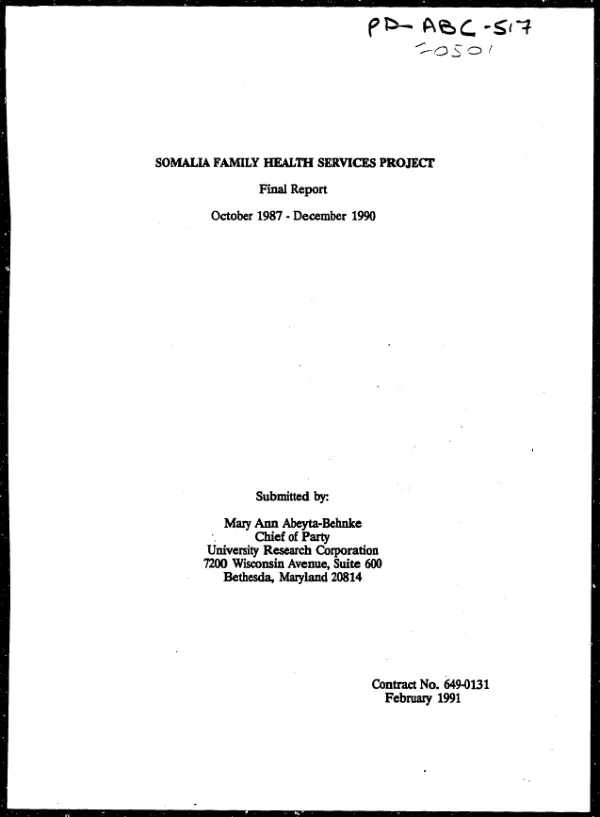
Somalia family health services project : final report -- October 1987-December 1990
University Research Corporation implemented the Family Health (FH) Services project in Somalia from 1985 through 1990.
Abeyta-Behnke, Mary Ann · 1991
Sign in to readA free account is required to download.
Abstract
The project was designed to strengthen the capability of Somali institutions to implement FH programs, and included: (1) population data and policy; (2) information, education, and communication (IEC); (3) clinical services; and (4) operations research. The project was one of the few still functioning in Somalia when all foreigners began an ordered departure in early December 1990 due to the encroaching civil war and violence that had become endemic in Mogadishu. With a rapid deterioration of the economy and reduced donor assistance, exacerbated by war and insecurity, women and children stood to lose the most. Not surprisingly, the project continued to function because it was working with women, and they were committed to help their less fortunate sisters. In addition, the work served as a distraction from the chaos and fear all around them. As the security situation steadily worsened and travel and communications with the four project regions outside Mogadishu became difficult and dangerous during 1990, the project shifted its focus to activities in Mogadishu. Greater emphasis was placed on developing policies and procedures, training manuals, and educational materials. Visible outputs and important progress were made by the project: indigenous skills improved; cooperation between the six implementing agencies was better than anyone ever imagined; educational materials were produced; the census was taken; FH awareness increased and created a demand; health education textbooks for grades 1-6 were published; "Where There Is No Doctor" was adapted and translated into Somali; clinical FH services were integrated into maternal/child health (MCH) services in Mogadishu after extensive training and monitoring; and mass media campaigns became familiar. The total realization of these outputs has waned, however, with the recent evacuation of the entire expatriate community and the severe destruction and looting that resulted when Mogadishu became the field of battle between government and rebel forces. In 1989 it became increasingly apparent that the government was unfortunately incapable of sustaining the progress made in the project, so concerted efforts were made to enlist other donor commitments. Eventually, UNFPA agreed to support the project; this was deemed beneficial to all, since the USAID and UNFPA programs were similar. As health and population advisors return to Somalia, they may benefit from reading this report. Appendix E contains a list of key Somali staff who may still be in country and who may be available to assist; the need for services is greater than ever. The following lessons were learned. (1) UNFPA has funded family planning activities through the MCH Division of the Ministry of Health (MOH) for the last 3 years. This has resulted in duplication, a waste of scarce resources, and confusion over responsibilities. In 1990, UNFPA took steps to remedy the situation. Better communication and coordination from the beginning of the project would have alleviated the duplication. (2) Because the government was unable to pay adequate salaries, the MOH used donor funding to pay salaries (referred to as incentives) to all persons directly and indirectly involved in their programs. Although project funds came from the sale of P.L. 480 commodities through the Ministry of Finance (MOF), there was extreme pressure to pay "incentives" to persons above the division director (for example, checks would not be approved until money was received), and to all nurses at the MCH centers (services would be withheld or not offered, until they received incentives). Incentives were also used to pay persons attending workshops or conferences because for many it was their only means of survival. Severe problems arose in late 1990, as donor funding diminished and the MOF was not releasing local funds for project support. It was learned that each MOH program had different "incentive" structures for the staff. This created ill will, disillusionment, and resentment, as well as a constant reshuffling of persons from one division to another. The donors began coordinating with one another in an attempt to remedy the situation, and this should continue. (3) The country"s weakening economic and political situation threatened even modest levels of sustainability. In retrospect, these factors were pervasive enough to clearly limit the country"s ability to maintain project activities without donor funding. Furthermore, the government"s ideological commitment to the poor was not particularly strong compared to its need for remaining in power. As systems began to fail, it became clear that the donors should have collaborated more closely, coordinated their resources, and prioritized their activities much earlier. (4) Visible outputs must be produced in a timely manner after they are developed and tested in order to keep motivation and enthusiasm high. (5) The purchase of project equipment should be carefully planned in terms of need, utilization, and recurrent costs. Discussions should be held with: (a) the Ministry of National Planning to ensure that the equipment or vehicles are included in the government"s 5-year plan, and (b) other donors to avoid duplication. (Author abstract, modified)
Related documents
![Comprehensive postpartum [post partum] project (CPP) : final report](https://covers.devme.ai/gen/74461.webp)