USAID. MISSION TO SOUTH AFRICA
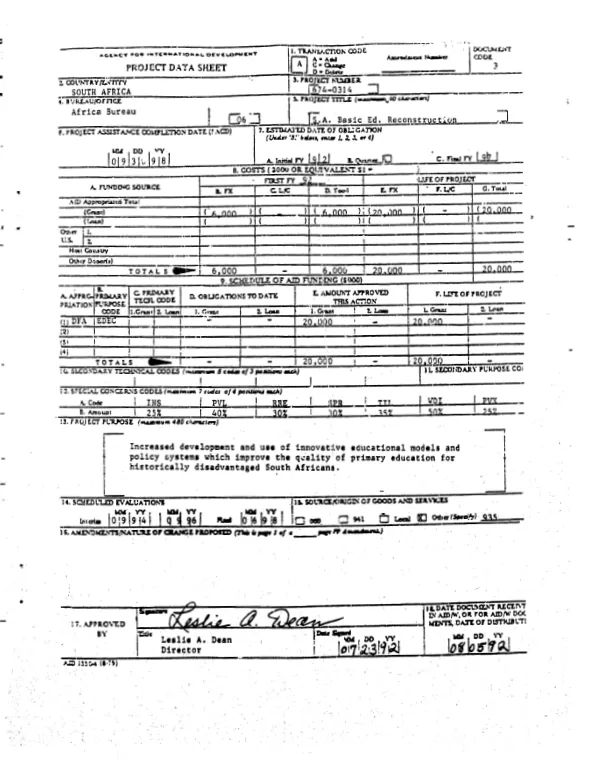
South Africa basic education reconstruction (SABER)
Project to improve educational quality for historically disadvantaged South Africans by developing innovative educational models and policy systems that promote a democratic, non-racial, non-sexist, compulsory, unitary educational system.
1992
Sign in to readA free account is required to download.
Abstract
The project will be implemented in three phases: (1) support to nongovernmental organizations (NGO"s); (2) support for an interim education negotiating forum; and (3) support to a post-apartheid South African Government. Phase I will consist mainly of grants to NGO"s for projects to make South Africa"s basic education system more democratic and egalitarian -- in reference to both race and gender -- in anticipation of a post-apartheid society. Six grants, mostly to NGO"s who have received prior grants under the Educational Support and Training Project (6740302), will be funded, as will a buy-in to LearnTech, a component of project 9311109. Efforts will focus on four subsectors within the primary and pre-primary sectors: curriculum development, school administration, teacher training, and educational materials and technology. Training and TA will be provided to help the grantees to improve their monitoring systems and to develop management information systems. Phase I of the project will also finance policy reform and research aimed at preparing black opposition leaders to negotiate and promote a new education system. Support to NGO"s will continue in Phases II and III. Phase II will provide TA to the interim education negotiating body of the black majority transition government, which is expected to be formed sometime between 1992 and 1994. Assistance to this body, which is provisionally known as the Education Reconstruction Forum (ERF), will focus on identifying desirable policy options and redesigning the education system along the lines indicated above. Project efforts to improve monitoring will shift increasingly to emphasize policy during this phase; a case study approach may be used. To commence Phase II, the project will require that the black majority in the ERF request assistance formally. The phase will end when an election is held and a new constitution, guaranteeing basic education for all children, is adopted. Phase III, which is not yet authorized or funded under the project, will commence after election of a new government and the removal of U.S legislative restrictions on direct assistance to a South African government. It will consist of grants and TA to the new government in the four above-noted educational subsectors for the period of about a year, while a large bilateral primary education project is being prepared.
Related documents