ACADEMY FOR EDUCATIONAL DEVELOPMENT, INC. (AED)
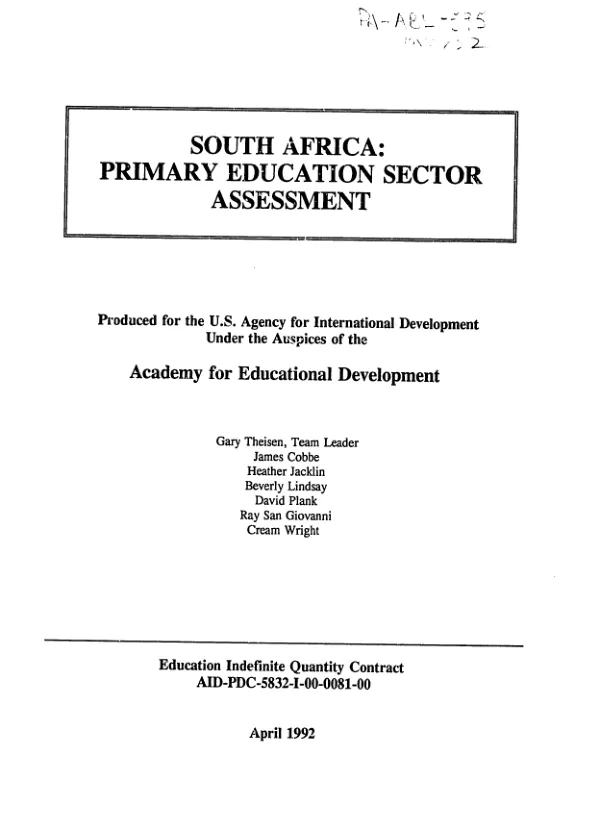
South Africa : primary education sector assessment
South Africa"s present state of transition to a post-apartheid society forms the dynamic context for this assessment of the country"s primary education system.
Theisen, Gary; Cobbe, James · 1992
Sign in to readA free account is required to download.
Abstract
Individual chapters of the assessment cover: (1) the structure, differentiation, and inequality of the primary education system; (2) an economic and financial analysis of the system; (3) educational administration and management; (4) curriculum reform (including criteria for an ideal curriculum); and (5) teacher education and training. According to the report, reform of South Africa"s primary education system will require a unitary system of administration and management, greater participation of local communities, and appropriate shifts in the country"s social and economic policies. Five recommendations which work towards the above goals are presented. (1) New financing schemes and greater efficiency are needed to combat a scarcity of resources, and to strengthen the weak pre-primary programs which cause high failure rates among African children, especially in the first 2 years. (2) Equalizing resource allocations to all students must become a top government priority. (3) A unitary education system with common standards, core curricula, and uniform processes, procedures, and rewards is necessary for lasting systemic change. (4) The low quality and irrelevancy of current curricula are a major impediment, which must be addressed. (5) Teachers" weak technical and pedagogical background must be improved to ensure higher student continuation and achievement rates. This can be achieved cost-effectively through the development and distribution of teacher guides and supplemental instructional materials.
Related documents
![Ethiopia education sector review : preliminary report [part I]](https://covers.devme.ai/gen/68241.webp)