USAID. MISSION TO SUDAN
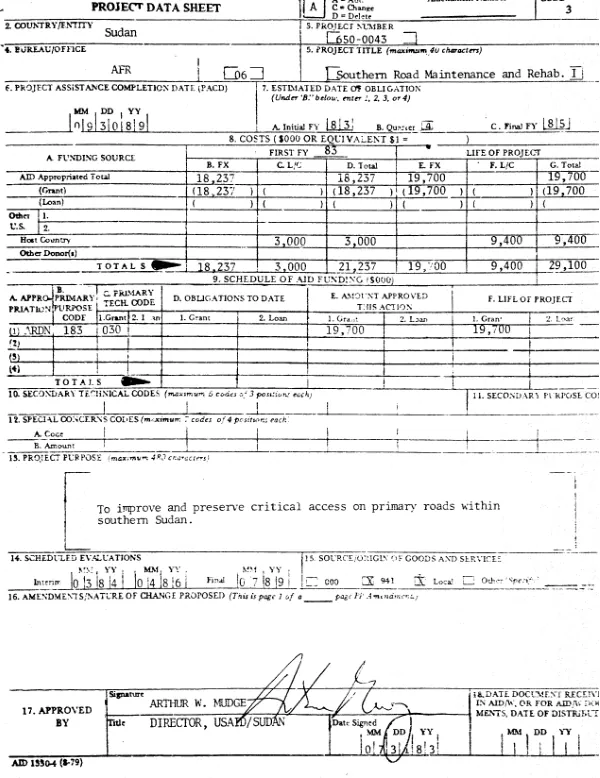
Southern road maintenance and rehabilitation I
Project, Phase I of a long-term effort to rehabilitate and maintain priority primary roads in southern Sudan.
1983
Sign in to readA free account is required to download.
Abstract
The project will focus on Equatoria and Bahr El Ghazal regions and will be implemented primarily by the Ministry of Construction and Public Works acting through the Roads and Bridges Corporation. The project will rehabilitate to Sudan"s modified Minimum Commercial Access standard 290 kms of key sections along the Juba-Torit-Kapoeta and Wau-Rumbek-Mundri road links and concurrently will conduct maintenance and regravelling operations over 1,469 km of exisitng road sections. A U.S. firm will supervise these activities and provide on-the-job training to Sudanese foremen, equipment operators, mechanics, and other skilled workers; in addition, B.S. training will be provided to 4 Sudanese engineers and short-term third-country training to 20 foremen. Three subregional equipment maintenance shops/camps will be established - at Mundri, Torit, and Rumbek. A.I.D. will provide heavy road machinery and support equipment as well as shop equipment, tools, and fuel. Existing labor-intensive maintenance camps will be provided with hand tools and limited TA. The capacity of the existing equipment workshop at Juba to provide major repair and maintenance services (those beyond the capabilities of the subregional shops) will also be upgraded through TA, on-the-job training, and provision of tools, equipment, and spare parts. In addition, a Caterpillar component exchange and rebuild program will be established with the Sudan Tractor Co. (Caterpillar dealer in Khartoum); the company will open a minor repair facility in Juba and perform major repairs and rebuilding at the Caterpillar shop in Wad Medani, providing on-the-job training at both locations. Project headquarters will be established in Juba, where two counterparts will be trained on-the-job in spare parts management and accounting. Local construction contractors will implement several of the project"s ancillary activities, e.g., construction of the subregional workshops and of staff housing, and, possibly, installation of simple drainage structures. Since the capability of these firms is limited, support will be provided in the form of equipment, construction materials, and technical supervision.
Related documents