USAID DEC
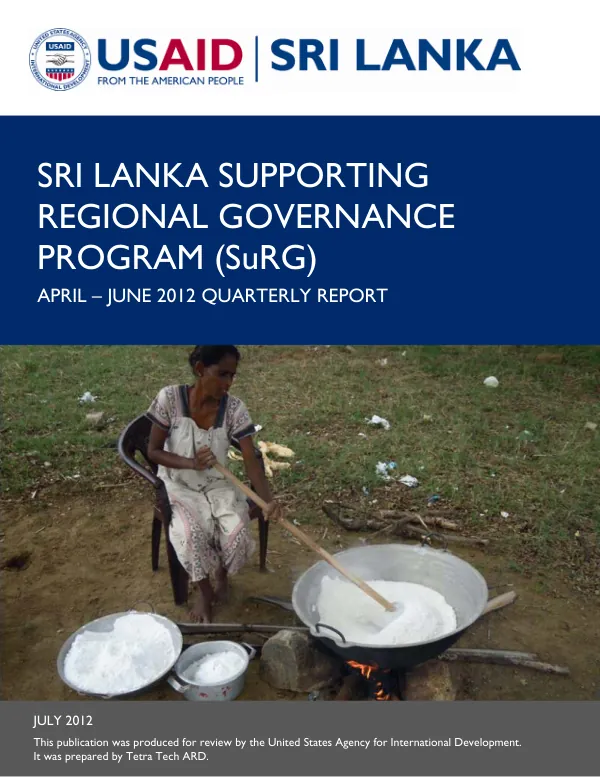
Sri Lanka Supporting Regional Governance Program (SuRG); April – June 2012 Quarterly Report
Sign inTETRA TECH ARD, INC.
Sri Lanka Supporting Regional Governance Program (SuRG); April – June 2012 Quarterly Report
The Supporting Regional Governance Program (SuRG) in Sri Lanka was initiated in March 2008 to address development needs resulting from the ongoing conflict.
2012 · 46 pages
Sign in to readA free account is required to download.
Abstract
The program was designed to build on USAID/Sri Lanka's democracy and governance efforts by focusing on four program components: social equity, local governance, community empowerment and transformation, and open dialogue. These components aimed to reinforce governance improvements around the betterment of human security. SuRG expanded its programming to include targeted initiatives in the Northern Province after the defeat of the Liberation Tigers of Tamil Eelam (LTTE) by the Government of Sri Lanka (GOSL) in May 2009. In December 2010, USAID extended the contract base period from February 2011 to June 2012. A modification to Section C of the contract and the budget was signed in July 2011, reflecting changes in the operating environment in Sri Lanka and USAID programming priorities. During the quarter from April 1–June 30, 2012, SuRG continued to provide technical assistance and support to 22 grantees, 44 local authorities, and members of the legal community. SuRG grantees reached out to women, youth, victims of human rights abuse, and their families to provide legal advice and support, access services, help them raise their voices, provide livelihoods and psychosocial support, build their capacity, and build bridges across ethnic and religious communities in the East, Polonnaruwa, Monaragala, Puttalam, Jaffna, Hambantota, and Colombo. SuRG training this quarter included a workshop for lawyers, judges, and law students from the North on labor law, a workshop on gender inclusiveness in local government based on the findings of mini-case studies on women's participation in two Eastern Province Pradeshya Sabha (PS) areas, a workshop on by-laws formulation for PS elected officials and government staff, and Tamil and Sinhala language classes. A total of 1,500 people, including 289 local government officials, 86 religious leaders, and 1,125 women, youth, and community members, participated in these language classes. At nine legal mobile clinics, 450 persons received support preparing applications, and SuRG grantees reached out to women, youth, victims of human rights abuse, and their families to provide legal advice and support, access services, help them raise their voices, provide livelihoods and psychosocial support, build their capacity, and build bridges across ethnic and religious communities. SuRG continued to support regional governance in the Eastern Province and Polonnaruwa District, with a focus on building on USAID/Sri Lanka's democracy and governance efforts to address development needs resulting from the ongoing conflict. SuRG's activities during the quarter included providing technical assistance and support to 22 grantees, 44 local authorities, and members of the legal community. SuRG grantees reached out to women, youth, victims of human rights abuse, and their families to provide legal advice and support, access services, help them raise their voices, provide livelihoods and psychosocial support, build their capacity, and build bridges across ethnic and religious communities. SuRG training this quarter included a workshop for lawyers, judges, and law students from the North on labor law, a workshop on gender inclusiveness in local government based on the findings of mini-case studies on women's participation in two Eastern Province Pradeshya Sabha (PS) areas, a workshop on by-laws formulation for PS elected officials and government staff, and Tamil and Sinhala language classes. The program's focus on social equity, local governance, community empowerment and transformation, and open dialogue aimed to reinforce governance improvements around the betterment of human security. SuRG's activities during the quarter demonstrated its commitment to building on USAID/Sri Lanka's democracy and governance efforts to address development needs resulting from the ongoing conflict.