AECOM INTERNATIONAL
Stability in Key Areas (SIKA) –West Weekly Report, January 7-13, 2014
The District Government Capacity Index (DGCI) survey was conducted in six districts of Afghanistan, including Muqur, Qadis, Shindand, Kushk Rabat-e Sangi, Chaghcharan, and Bala Boluk.
2014 · 7 pages
Sign in to readA free account is required to download.
Abstract
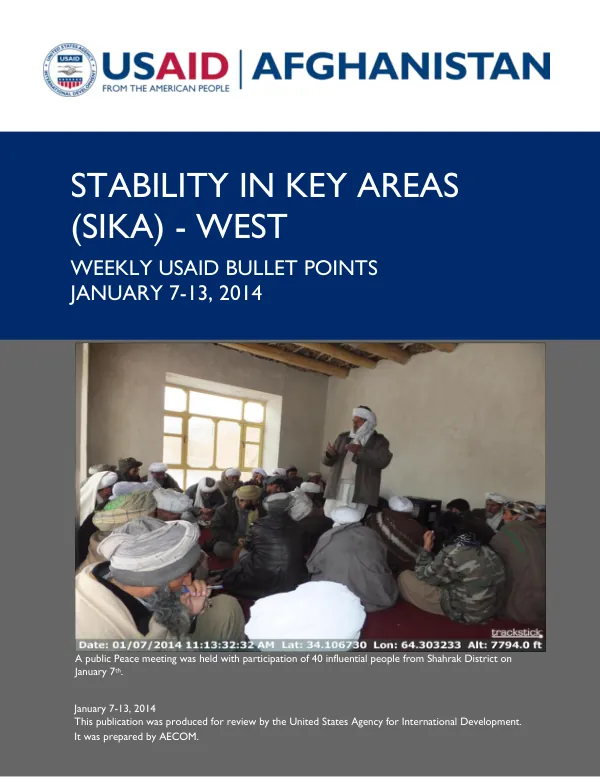
A third-party organization, Tadbeer, was contracted to implement the initial assessment. A four-day assessment training was provided to the assessment team from January 5th-8th, covering topics such as interview techniques, good governance, and the purpose of the District Government Capacity Index. The assessment was conducted in the aforementioned districts, and once completed, the District Governors will receive strategic planning, management, public outreach, service delivering, and other needs-based trainings. The District Government Capacity Index aims to improve the capacity of district governments in Afghanistan, enabling them to provide better services to their citizens. In Farah Province, 113 rehabilitation grant projects are ongoing, including water dividers, bridges, culverts, flood protection walls, community center refurbishments, and road rehabilitations. Additionally, 72 vocational grant trainings are ongoing in Farah, Herat, Badghis, and Ghor Provinces, covering skills such as tailoring, embroidery, carpet weaving, welding, carpentry, and auto-mechanic courses. In Badghis Province, the Muqur District Governor organized a coordination meeting with 13 district government staff on January 12th, discussing issues such as the use of expired food and medicines in the bazaar and speeding of Afghan National Police (ANP) and Afghan National Army (ANA) vehicles in residential areas. Conflict Resolution Skills training was provided to the Muqur DG and the Tribal Conflict Resolution Committee (TCRC) on January 12th, with eight members of the TCRC assigned to mediate between conflicting parties in Surkhabi and Jakana villages. In Herat Province, the Kushk Rabat-e Sangi District Governor received support to create a Facebook page, enabling him to post district government achievements and activities, job vacancies, and important events. Report Writing training was provided to the Kushk Rabat-e Sangi District Governor, DRRD focal point, and three district key staff on January 12th, with the aim of cascading the training to TCRC members to enable them to report their activities and achievements. In Ghor Province, Conflict Resolution Skills training was provided to 28 members of the Shahrak TCRC on January 7th, with the TCRC working at the district level to identify, prioritize, and resolve conflicts. A Peace meeting was held in Shahrak District with participation of 40 influential people, including government officials, Ulema, and elders, on January 7th, emphasizing the importance of peace and unity in the community. The District Government Capacity Index (DGCI) survey aims to improve the capacity of district governments in Afghanistan, enabling them to provide better services to their citizens. The ongoing rehabilitation grant projects and vocational trainings in Farah, Herat, Badghis, and Ghor Provinces are contributing to the development of these provinces. The establishment of Facebook pages by district governors in Herat Province will enable them to share their achievements and activities with the public. The Conflict Resolution Skills training provided to TCRC members in Badghis and Ghor Provinces will help them to resolve conflicts at the district level.