AECOM INTERNATIONAL
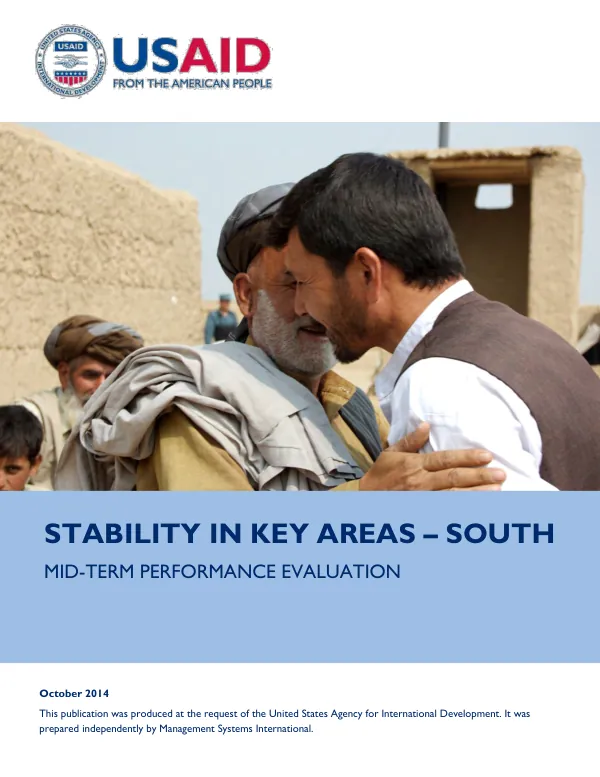
Stability in Key Areas – South: Mid-Term Performance Evaluation
Stability in Key Areas (SIKA)-South is a program implemented by Architecture, Engineering, Consulting, Operations and Maintenance International Development (AECOM) to expand and improve the legitimacy of the Government of Islamic Republic of Afghanistan (GIRoA) at the sub-national level.
2014 · 90 pages
Sign in to readA free account is required to download.
Abstract
The program works closely with the Ministry of Rural Rehabilitation and Development (MRRD) and the Independent Directorate of Local Governance (IDLG) to implement development projects, facilitate governance and democracy initiatives, and deliver training and mentoring to district and provincial line entities. SIKA-South began piloted programming in Daman in July 2012 and currently covers Zabul, Helmand, Nimroz, Kandahar, and Uruzgan provinces. The program's strategy in these locations involves assisting district entities to better understand their operating environment and identify the challenges to stability they face, and then enabling district governments to implement activities aimed at addressing identified sources of instability (SOIs). District government confidence-building initiatives, mitigation activities, and grants are among the programming components aimed at addressing community-identified SOIs. The mid-term performance evaluation of SIKA-South's grants and activities up to the end of March 2014 focused on Kandahar, Zabul, and Helmand provinces, covering the six districts where the majority of programming has taken place. The evaluation team consisted of one expatriate monitoring and evaluation (M&E) Specialist, two Afghan advisors based in Kabul, and one interviewer in each of the three provinces. The evaluation aimed to assess the effectiveness of SIKA-South's programming in addressing SOIs and improving stability in the targeted districts. The evaluation methodology included data collection through interviews with key stakeholders, observation of program activities, and review of program documents. The evaluation team also conducted a theory of change analysis to understand the underlying assumptions and logic of SIKA-South's programming. The evaluation found that SIKA-South's programming has contributed to improved stability in the targeted districts, particularly in terms of increased community engagement and participation in local governance initiatives. The program's focus on addressing community-identified SOIs has helped to build trust and confidence in the district governments, which has led to improved relationships between the government and the local population. However, the evaluation also identified several challenges and limitations to SIKA-South's programming, including limited capacity and resources at the district level, inadequate coordination and communication between program stakeholders, and a lack of clear and consistent monitoring and evaluation systems. The evaluation team recommended that SIKA-South and its partners address these challenges through increased capacity building and training for district officials, improved coordination and communication, and the development of more robust monitoring and evaluation systems. The evaluation also highlighted the importance of continued support for SIKA-South's programming, particularly in terms of funding and technical assistance. The program's success in improving stability in the targeted districts has significant implications for the broader stability and security of Afghanistan, and continued support is necessary to build on this progress and achieve long-term stability and development outcomes.