USAID DEC
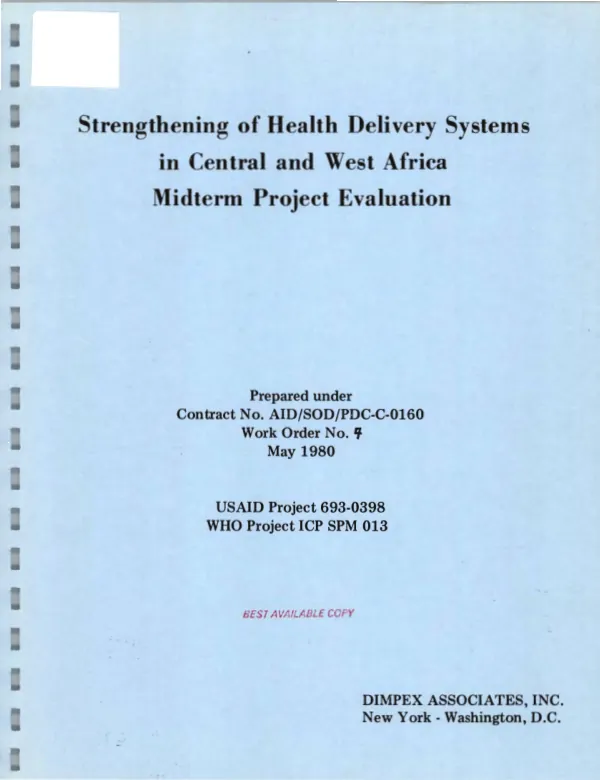
STRENGTHENING OF HEALTH DELIVERY SYSTEMS IN CENTRAL AND WEST AFRICA, MIDTERM PROJECT EVALUATION
Sign inDIMPEX ASSOCIATES, INC.
STRENGTHENING OF HEALTH DELIVERY SYSTEMS IN CENTRAL AND WEST AFRICA, MIDTERM PROJECT EVALUATION
Evaluates project to enhance the capabilities of 20 Central and West African countries to plan and manage health delivery systems.
1980
Sign in to readA free account is required to download.
Abstract
Special evaluation covers 9/77-4/80. The project is on track and administration by WHO/AFRO has been satisfactory. In the disease surveillance and health information systems SP, epidemiologists assigned to The Gambia, Upper Volta, and Cameroon are developing disease surveillance systems for these and surrounding countries and have been assisted by operations officers and PCV's responsible for immunization demonstrations. Baseline data on morbidity and mortality from neonatal tetanus, polio, and measles were collected in the same 3 countries. Full implementation of the expanded immunization programs is being hindered by an unreliable cold chain. A heat stable vaccine, however, was developed and will be available in 1980. Measles immunizations in Liberia and The Gambia were disrupted by late shipment of vaccine. Two training courses for 83 national managers on expanded immunization programs have been held. In the Research and Evalution of Low Cost Delivery Systems SP, affordable health delivery systems have not been developed. Guidelines for applied research on health delivery and primary health care (PHC) were established, although research approval procedures have not yet been determined. Proposals were made for a cost-benefit study of the Ivory Coast's immunization program and for a regional purchasing, storage, and distribution system for medical supplies. In the health planning and management (HPM) SP, programming courses for senior health administrators were held at the Dakar HPM center, whose future role will be discussed at the Arusha Conference. A course was designed for mid-level planners, and a top-level management interministerial workshop was developed for planners from nine countries. A health plan for Liberia based on a country health programming exercise was devised. Under the nursing and village health worker (VHW) training SP, a post-basic nursing center is being developed at Liberia's Cuttington College (CC). A curriculum workshop was held for persons from Sierre Leone, Liberia, and The Gambia. CC faculty are concerned that introducing PHC training (the need for which among field workers they consider doubtful) may prolong the B.S. program and that the possible lack of qualified students may delay implementation at the country level. Three CC faculty are studying advanced nursing education in the U.S., although none are from The Gambia or Sierre Leone. Post-basic nursing curricula are being revised in both Dakar's and Yaounde's Centres d'Enseignment Superior en Soins Infirmiere programs. At the Lome Regional Training Center for VHW Trainers, a training manual adaptable by students to in-country use was developed. VHW training was also begun in Lagos.