USAID DEC
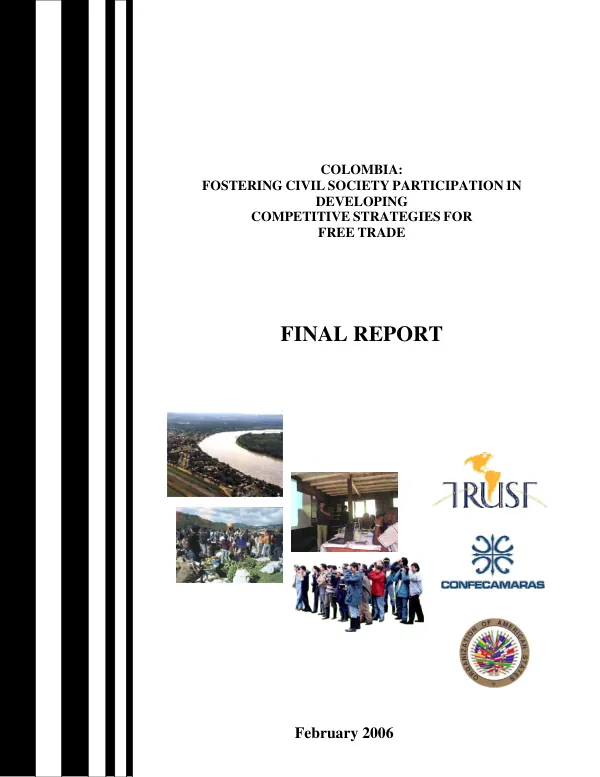
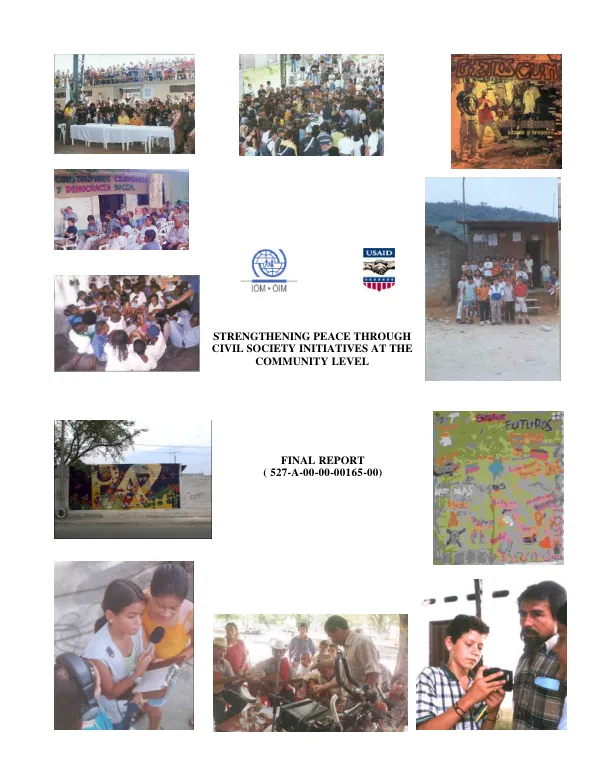
Strengthening peace through civil society initiatives at the community level : final report (527-A-00-00-00165-00)
Sign inINTERNATIONAL ORGANIZATION FOR MIGRATION (IOM)
Strengthening peace through civil society initiatives at the community level : final report (527-A-00-00-00165-00)
Final report of the International Organization for Migration (IOM) on a project (ending 9/02) to promote peace in Colombia by strengthening civil society organizations (CSOs) and CSO initiatives at the community level.
1970
Sign in to readA free account is required to download.
Abstract
The project provided support to 29 CSOs (3 during the last quarter) for the design/formulation of an equal number of projects. Activities were carried out in 28 municipalities in 12 departments, to the direct or indirect benefit of 24,231 and 89,375 persons, respectively. Almost 19 million Colombians benefitted as a result of the extended impact of the projects. In terms of resource allocation, the project spent roughly 2/3 of its budget for regional initiatives and 1/3 for projects with a national coverage. Specifically, 38% of project funds were spent on assistance to victims, excluded groups, and ethnic minorities; 30% on awareness raising through message broadcasting and community media; 21% to support Peace Commissioners; and 11% to enhance civil society participation in peace processes. As a result of the project, nine regional and local NGOs were strengthened institutionally and their ability to design and formulate projects was increased. Also strengthened were 15 NGOs based in Bogota but having national coverage. Extensive coordination was carried out with regional government agencies for the support of five departmental offices of the Peace Commissioners. Six pilot projects to strengthen local peace commissioners and to make more visible the current armed conflict issue were implemented through the support program for the Peace Commissioners. Four projects were extended and transferred to the strengthening peace program: research on journalist ethics during war time; a peace curriculum designed by college students and validated in marginal communities; construction and implementation of the Colombian ethnic minorities web page; and extended support to Peace Commissioners" offices. These projects were transferred because of their efficiency, effectiveness, and opportunity in the implementation of the projects, as well as their relevance in the construction of a path of peace. Lessons learned are as follows: (1) It is socially profitable to work with small organizations only if the project includes institutional strengthening and performs continuous monitoring. (2) It is viable to propose the implementation of peace initiatives in geographical areas that are deeply affected by the armed conflict or difficult to access. (3) Even if the number of direct beneficiaries of a project is modest, extended impact justifies the investment. This is specifically the case of the community radio stations or projects that include awareness-raising campaigns. (4) It is possible to coordinate and implement projects between government agencies at the local level and CSOs. (5) We should continue supporting initiatives and continue working with youth. They have proven to be committed and engaged in the construction of a peaceful environment. (6) It is necessary to continue strengthening and consolidating ethnic minorities and Afro-Colombian organizations. (7) The international community should persevere in promoting peace initiatives from CSOs. (8) Local authorities hard-hit by the conflict are more engaged to generate governance spaces than national authorities. (9) It is more relevant to support the developing of processes than to support specific activities, even if the latter are more attractive to the media and afford greater visibility.