JOHN SNOW, INC. (JSI)
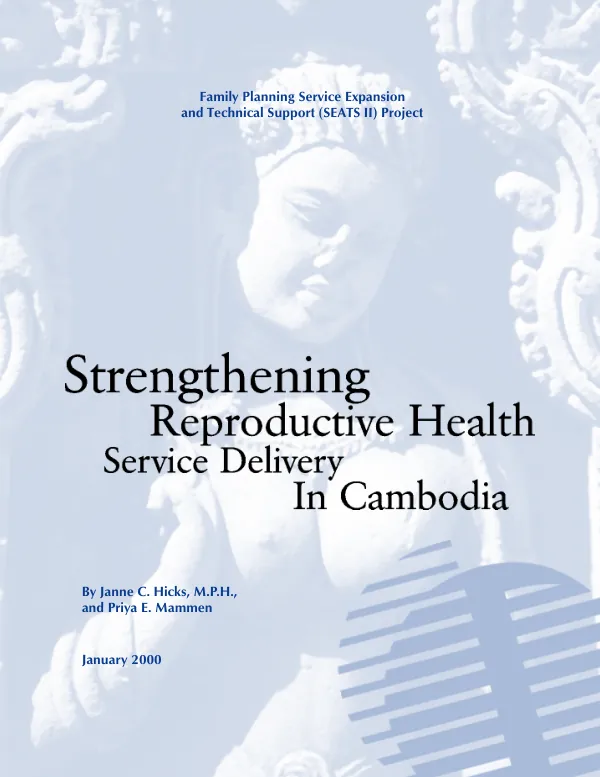
Strengthening reproductive health service delivery in Cambodia
This paper documents the achievements of three projects supported by the Family Planning Service Expansion and Technical Support Project (SEATS) in Cambodia : two indigenous organizations, the Reproductive Health Association of Cambodia (RHAC) and the Cambodian Midwives Association (CMA), and a technical support project, the Reproductive and Child Health Alliance (RACHA).
Hicks, Janne C.; Mammen, Priya E. · 2000
Sign in to readA free account is required to download.
Abstract
Individual sections of the report: introduce Cambodia"s challenges and efforts in health sector reform; explore five technical interventions SEATS and its partners have undertaken to improve access to and quality of sustainable family planning/reproductive health (FP/RH) service delivery programs in Cambodia (safe motherhood, service expansion and outreach, logistics management, quality improvement, and organizational development); and summarize program experiences and lessons learned. Although a great deal of work remains to be done, Cambodia"s RH situation has improved significantly in the last 3 years. Service delivery output has increased, service quality has been enhanced, and prospects for sustaining services have improved. The use of modern birth spacing methods has more than doubled (from 7% to 16%), and fertility among all age groups has shown a corresponding decline. SEATS and its partner organizations have contributed to these gains by emphasizing access to quality RH services, a client and community orientation, national policies and guidelines, training and Continuous Quality Improvement (CQI) systems, and program sustainability. RHAC and CMA have responded well to a volatile environment, increasing the likelihood that they will be able to continue providing RH services to Cambodians. CMA has grown from a nascent association to one that plays a vital role in increasing the quality of midwifery services and access to those services. The Ministry of Health now realizes the important role of midwives, along with doctors, in providing quality RH care. Lessons focus on building a collaborative and reciprocal relationship with government; the need to extend the project timeline when dealing with new indigenous NGOs; cultural barriers to midwifery practice; the importance and difficulty of translating project materials into Khmer; the need to adapt test procedures to Cambodian sensibilities; and the scarcity of well-trained health professionals and health care workers in Cambodia.
![Expanding access to reproductive health through midwives[ : the MAPS initiative]](https://covers.devme.ai/gen/5677.webp)
![Expanding access to reproductive health through midwives[ : the MAPS initiative]](https://covers.devme.ai/gen/22585.webp)