USAID DEC
Success Story: The Importance of Local Safety Councils and the Role of Youth as Promoters of Change
Sign inNATIONAL PLANNING DEPARTMENT
Success Story: The Importance of Local Safety Councils and the Role of Youth as Promoters of Change
The establishment of Local Safety Councils has been a crucial step in addressing security issues in various municipalities.
2020 · 1 pages
Sign in to readA free account is required to download.
Abstract
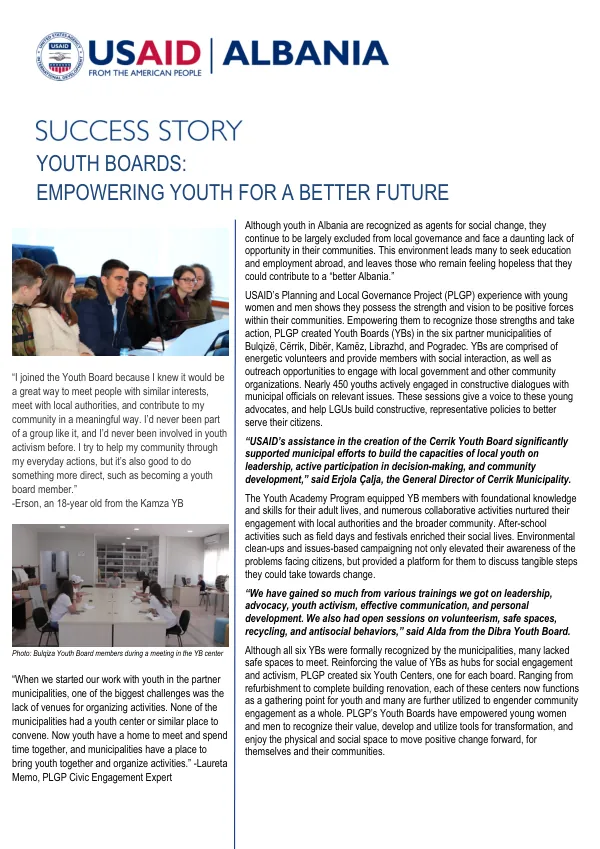
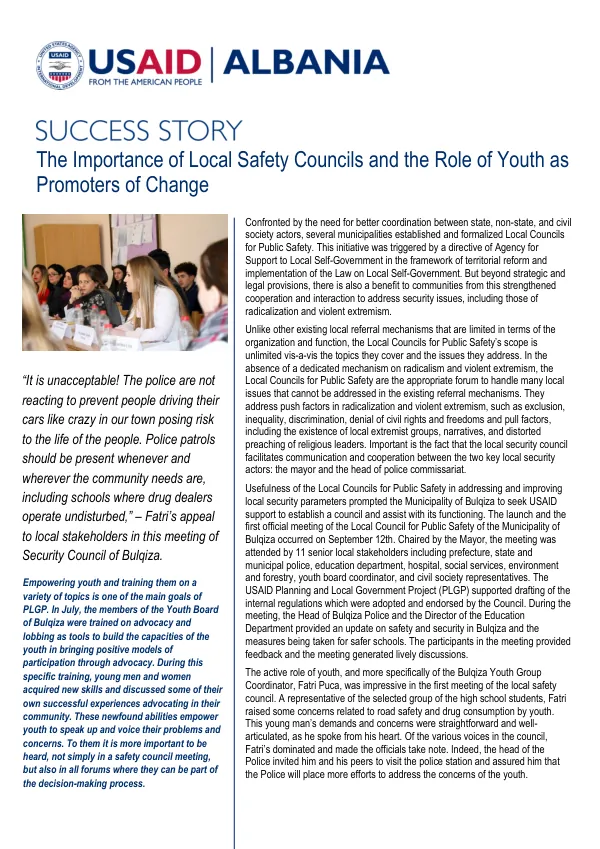
In the context of Bulqiza, the formation of the Local Council for Public Safety was prompted by the need for better coordination between state, non-state, and civil society actors. This initiative was triggered by a directive of the Agency for Support to Local Self-Government in the framework of territorial reform and implementation of the Law on Local Self-Government. The Local Councils for Public Safety have an unlimited scope in terms of the topics they cover and the issues they address. Unlike other existing local referral mechanisms, these councils are equipped to handle complex issues such as radicalization and violent extremism. They address push factors in radicalization and violent extremism, including exclusion, inequality, discrimination, denial of civil rights and freedoms, and pull factors, including the existence of local extremist groups, narratives, and distorted preaching of religious leaders. The usefulness of the Local Councils for Public Safety in addressing and improving local security parameters has been demonstrated in Bulqiza. The Municipality of Bulqiza sought USAID support to establish a council and assist with its functioning. The launch and the first official meeting of the Local Council for Public Safety of the Municipality of Bulqiza occurred on September 12th, chaired by the Mayor. The meeting was attended by 11 senior local stakeholders, including prefecture, state and municipal police, education department, hospital, social services, environment and forestry, youth board coordinator, and civil society representatives. The active role of youth, particularly Fatri Puca, the Bulqiza Youth Group Coordinator, was notable in the first meeting of the local safety council. Fatri raised concerns related to road safety and drug consumption by youth, and his demands and concerns were well-articulated and straightforward. The head of the Police invited him and his peers to visit the police station and assured him that the Police will place more efforts to address the concerns of the youth. The empowerment of youth through training on advocacy and lobbying has been a key goal of the PLGP. In July, the members of the Youth Board of Bulqiza were trained on advocacy and lobbying as tools to build the capacities of the youth in bringing positive models of participation through advocacy. This training enabled young men and women to acquire new skills and discuss their successful experiences advocating in their community. The newfound abilities of the youth empower them to speak up and voice their problems and concerns, not only in safety council meetings but also in all forums where they can be part of the decision-making process.