USAID DEC
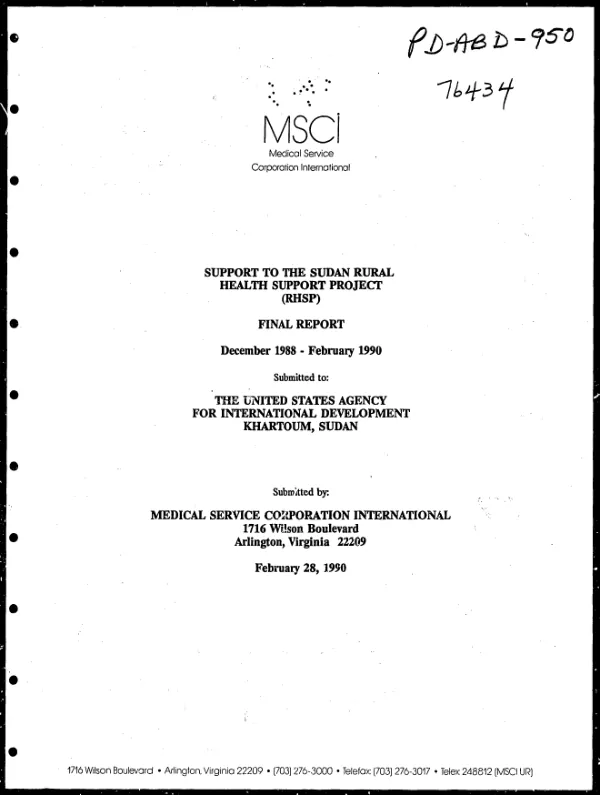
Support to the Sudan rural health support project (RHSP) : final report, December 1988-February 1990
Sign inMEDICAL SERVICE CORP. INTERNATIONAL
Support to the Sudan rural health support project (RHSP) : final report, December 1988-February 1990
Final report by the TA contractor -- Medical Service Corporation International (MSCI) -- on a project to upgrade the capacity of the Sudanese Ministry of Health (MOH) to provide primary health care (PHC) services in Kordofan and Darfur regions.
Swezy, F. Curtiss; Black, Glen E. · 1990
Sign in to readA free account is required to download.
Abstract
The report covers the contract period, 12/88-2/90. Management assistance stressed strengthening the role of the Regional Project Implementation Units (RPIU"s) to set policy and oversee program implementation. Support was given to developing a Health Information System (HIS), strengthening district-level support of PHC, expanding the sale of essential drugs to rural areas, and promoting community participation. This occurred particularly in the area of logistical support for drug and vaccine transportation. Logistical support was provided to the regional MOH directorates. A particular desire of regional MOH leaders, though not approved by USAID/S, was the creation of an MOH vehicle repair facility in each region. MSCI also distributed $247,000 worth of commodities. Training of clinical and paramedical personnel was emphasized, especially in Kordofan where the only regional health training unit in Sudan had been established by the project in 1987. Training of paramedical staff and community opinionmakers, such as schoolteachers, was also initiated in Darfur. In the area of child survival, TA was given in immunization (EPI), control of diarrheal disease (CDD), and nutrition. The project assisted the vertical EPI Program with program-specific needs (e.g., fuel and generator maintenance), and in Kordofan initiated the installation of 12 solar powered refrigerators to reduce reliance on mobile vaccination teams. In regard to CDD, support was given in Darfur for teacher training and the establishment of "ORT Corners" in hospitals and health centers. MSCI energized nutrition activities in both Kordofan and Darfur. In Kordofan, it took advantage of an A.I.D./W-funded project and conducted an ethnographic nutrition survey in rural districts. In Darfur, growth monitoring and vitamin A distribution were inaugurated. The MOH never appointed maternal child health/family planning (MCH/FP) Department Directors in either region during the contract period, significantly diminishing the project"s contribution in this area. Further, transportation difficulties made covering two regions with one advisor impractical. Nonetheless, in both regions MSCI succeeded in creating MCH/FP Steering Committees as technical advisory committees to the RPIU"s. Sanitation was a cornerstone of the project from the start, with an emphasis on teaching intermediaries, and then villagers, the technology of installing home privies and ventilated improved pit (VIP) latrines. In Kordofan, a manual on VIP construction was written and printed. Constraints on implementing a project in Sudan are formidable. Most surface travel is over desert tracks, intra-city air service is intermittent, and telecommunications are interrupted or nonexistent. MSCI was denied use of short-wave transceivers between its three sites. Travel and communications were more difficult in Darfur than Kordofan. It is unrealistic to believe that advisors can commute readily between regions, particularly to Darfur. The project design should have called for a smaller team of perhaps five, and worked only in one region (with a Khartoum backstop office). Alternatively, the team could have been even larger and the two regions treated as semi-independent projects. MOH counterparts should have been in place before the team arrived in-country. Failure to accomplish this implies less than full commitment to the project on the part of the MOH and the Government of Sudan (GOS). Finally, a majority of the MSCI team believes that USAID/S should have monitored counterpart expenditures by the MOH more closely. The prevailing method of thrusting responsibility on GOS ministries, while good development theory, inhibited the responsible management of counterpart funding. (Author abstract, modified)
Related documents
Documents in this collection
 2003
2003USAID DEC
PROGRESS (projet de gestion regionale des services de sante) : final report, July 2000-September 2003
Open record 2005
2005USAID DEC