USAID DEC
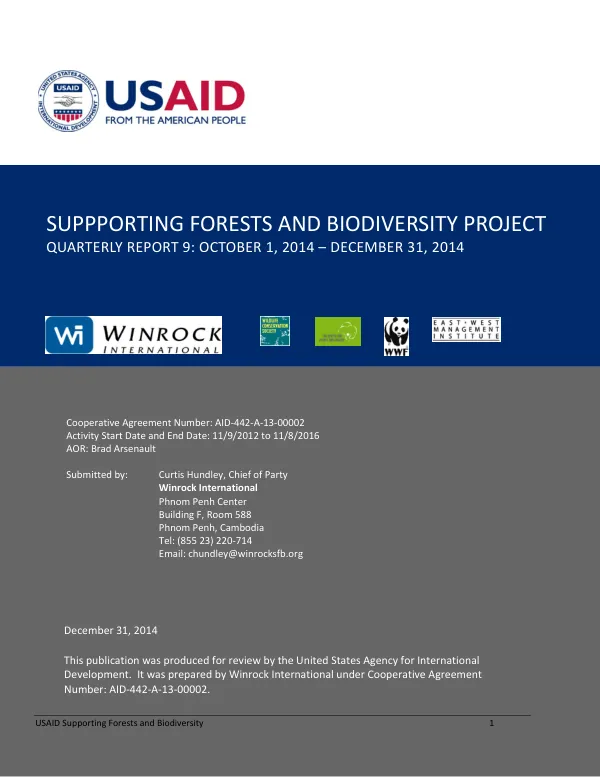
Supporting Forests and Biodiversity Project Quarterly Report 9: October 1, 2014 – December 31, 2014
Sign inEAST WEST MANAGEMENT INSTITUTE, INC.
Supporting Forests and Biodiversity Project Quarterly Report 9: October 1, 2014 – December 31, 2014
The Supporting Forests and Biodiversity Project in Cambodia began in November 2012 and is set to conclude in November 2016.
2014 · 111 pages
Sign in to readA free account is required to download.
Abstract
The project aims to conserve and sustainably manage forests and biodiversity in the Eastern Plains Landscape and the Prey Lang Landscape. The project is implemented by Winrock International, with the support of several subcontractors, including the Wildlife Conservation Society, the World Wide Fund for Nature, and the Center for People and Forests. The project's geographic coverage includes the Mondulkiri province in the Eastern Plains Landscape and the Kampong Thom, Preah Vihear, Stung Treng, and Kratie provinces in the Prey Lang Landscape. The project's objectives are to conserve and sustainably manage forests and biodiversity, promote sustainable livelihoods for local communities, and support the development of a national REDD+ program. During the reporting period of October 1, 2014, to December 31, 2014, the project made significant progress in achieving its objectives. The project's community forest management program continued to support the establishment of community forests, with a total of 15,000 hectares of forest area now under community management. The project also supported the development of a community investment plan, which aims to promote sustainable livelihoods for local communities. The project's law enforcement program continued to support the development of a management effectiveness tracking tool, which aims to monitor and evaluate the effectiveness of forest management in the project area. The project also supported the development of a provincial conservation planning unit, which aims to promote sustainable forest management at the provincial level. In terms of implementation challenges, the project faced difficulties in engaging local communities in the project's activities, particularly in the Prey Lang Landscape. The project also faced challenges in accessing remote areas, which hindered the project's ability to conduct field activities. The project's integration of crosscutting issues and USAID forward priorities continued to be a key focus area. The project supported the development of a gender equality and female empowerment plan, which aims to promote the participation of women in the project's activities. The project also supported the development of a monitoring and evaluation plan, which aims to track the project's progress and impact. The project's stakeholder participation and involvement continued to be a key aspect of the project's implementation. The project engaged with local communities, government agencies, and other stakeholders to ensure that the project's activities were aligned with their needs and priorities. In terms of management and administrative issues, the project continued to face challenges in managing its finances and human resources. The project also faced challenges in accessing information and communication technology, which hindered the project's ability to conduct field activities. The project's lesson learned highlighted the importance of engaging local communities in the project's activities and ensuring that the project's activities were aligned with their needs and priorities. The project also learned the importance of developing a robust monitoring and evaluation system to track the project's progress and impact. The project's planned activities for the next quarter included the continuation of the community forest management program, the development of a community investment plan, and the support of the development of a provincial conservation planning unit. The project also planned to continue its law enforcement program and support the development of a management effectiveness tracking tool. The project's annexes included a TraiNet report, which provided an overview of the project's progress and impact. The report highlighted the project's achievements in conserving and sustainably managing forests and biodiversity, promoting sustainable livelihoods for local communities, and supporting the development of a national REDD+ program.