USAID DEC
Survey of employment and earnings in the `formal" private sector of The Gambia, 1992-1994
Sign inUSAID. MISSION TO THE GAMBIA
Survey of employment and earnings in the `formal" private sector of The Gambia, 1992-1994
Data collected by USAID/Banjul between 1991 and 1994 on the performance of eight subsectors -- industrial fishing, horticulture, manufacturing, construction, tourism, transport, trade, and finance -- in the Greater Banjul area are synthesized to present a picture of the condition of and trends in The Gambia"s private sector.
Carr, Benjamin J. · 1995
Sign in to readA free account is required to download.
Abstract
The performance of the eight subsectors are examined collectively as well individually on the basis of number of establishments, total wages paid, wages paid by month, and number of persons employed; data are also disaggregated by gender. The private sector experienced a cycle of expansion and contraction between 1992-1994, with the expansion phase peaking in 1993; overall, however, it has contracted, in terms of number of establishments (down 16%), total wages paid (down 5%), and number of persons employed (down 26%), between 1992-1994. As can be deduced from these figures, the average number of employees per establishment has declined, but average wages in the private sector have risen steadily; however, this second finding should be interpreted with care, as the earnings increases of workers in high-income sectors, particularly transport, trade, and finance, likely mask real wage decreases in the other sectors. Interestingly, though women"s total employment decreased disproportionately, their average wages grew disproportionately, overtaking the average wage for men by the end of 1994; this is probably due to the relatively high proportions of women employed in the transport, trade, and finance sectors. Individually, all of the subsectors suffered varying levels of decline over the entire period, except for finance, which remained basically stable and showed sustained increases in average wages. Particularly hard hit were industrial fishing and construction. A final chapter discusses surveys conducted in the areas of Basse and Farafenni to fill in gaps where government information was lacking.
Related documents
Documents in this collection
 2004
2004USAID DEC
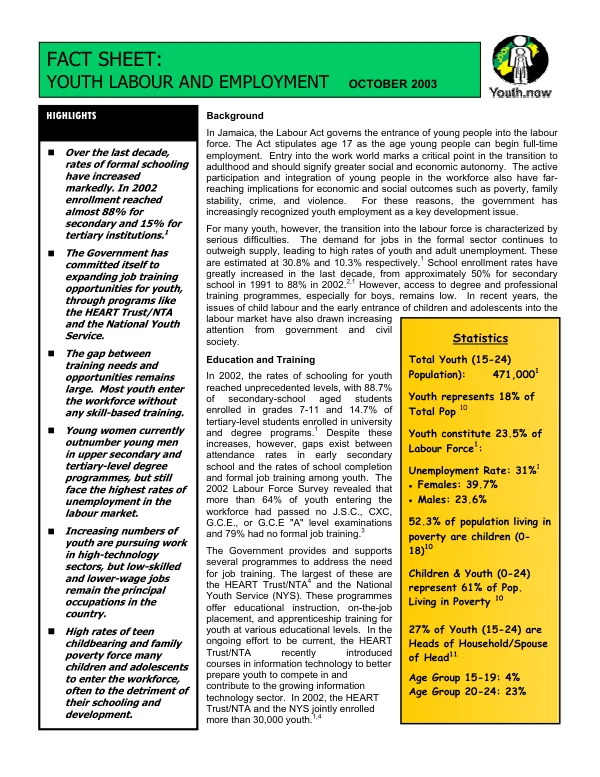
Youth.now fact sheet : youth labour and employment
Open record 1995
1995USAID DEC