INTERNATIONAL CENTRE FOR DIARRHOEAL DISEASE RESEARCH, BANGLADESH (ICDDR,B)
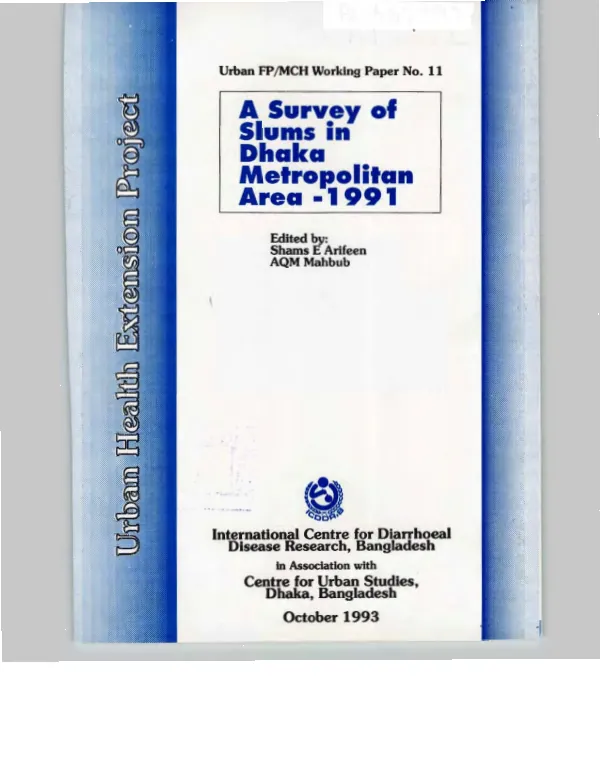
Survey of slums in Dhaka metropolitan area - 1991
Results are presented of a 1991 survey of slums (defined as areas with substandard housing, extreme population densities, and poor sewerage and water supply) in the Dhaka metropolitan area.
El Arifeen, Shams, ed.; Mahbub, AQM, ed. · 1993
Sign in to readA free account is required to download.
Abstract
The report includes: (1) a general profile of slums and slum dwellers in terms (inter alia) of land ownership patterns, household size, population density, and the topography of slum sites; (2) patterns and growth of slum settlements, covering the spatial distribution of slums, sources of slum populations, and the stability of slum and squatter settlements; and (3) slum infrastructure, with emphasis on quality of housing, access to water, sewers, electricity, and gas, and access to primary schools. The survey identified 2,156 slums, 81% of which had been established since 1971, the year Bangladesh became independent. Of the total, 75% were on private land, although slums on public lands were larger and had a more stable population. While acknowledging the difficulties of documenting slum conditions, the report finds environmental conditions in slums to be extremely poor, characterized by very high population density (225,000/sq km), poor housing (93% of houses were constructed of tin, wood, bamboo, or jhupri), and proneness to flooding. On the other hand, access to electricity and safe drinking water was high, especially in the private slums, although the same areas generally lacked primary schools. Includes 40 statistical tables.
![Issues for family planning in urban slums of Dhaka, Bangladeh [i.e. Bangladesh] : opinions and perceptions of field-level workers](https://covers.devme.ai/gen/53722.webp)