WORLD RESOURCES INSTITUTE (WRI)
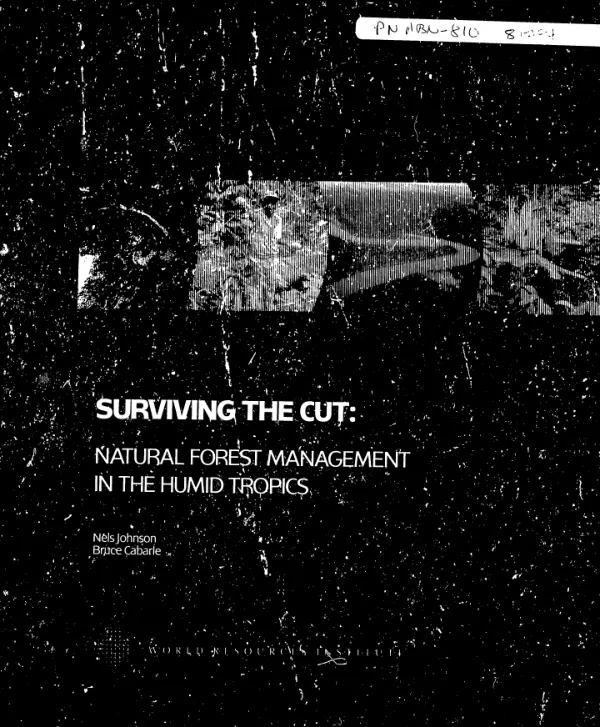
Surviving the cut : natural forest management in the humid tropics
From Siberia to Amazonia, forests everywhere are in trouble, with tropical forests vanishing at the rate of 17 million hectares a year and temperate forests seriously degraded by pollution and overharvesting.
Johnson, Nels; Cabarle, Bruce · 1993
Sign in to readA free account is required to download.
Abstract
One of the most vexing questions is whether sustainable forestry is possible in natural forests. The authors of this study analyze past forest management failures and chart a path toward more productive, sustainable, and equitable practices. They argue that a narrow focus on sustained timber yields often leads to failure. A project may be producing trees sustainably, for instance, but if timber is all that counts, species diversity may plummet and watersheds deteriorate almost without notice. To ensure a steady stream of valued forest products, the management goal must be to maintain the health of entire forest ecosystems and the well-being of local communities -- whether in the Pacific Northwest or Southeast Asia. The authors maintain that development theorists and practitioners have paid too little attention to the social, economic, and political dimensions of forest management, making it hard to gauge the sustainability of one practice or another. Besides analyzing the sometimes counterproductive effects of bans and boycotts, the authors provide criteria for rating various timber certification proposals. As they note, governments own or control nearly 80% of tropical forests, so these forests stand or fall accordingly to government policy. In the end, the authors call for a redefinition of natural forest management, bidding nations to take these steps towards sustainable forestry and enduring economic development. Includes 6-page bibliography. (Author abstract, modified)
Related documents
Documents in this collection
 2003
2003USAID DEC
USAID"s enduring legacy in natural forests : livelihoods, landscapes, and governance. Volume two : study report
Open record 2003
2003USAID DEC