USAID DEC
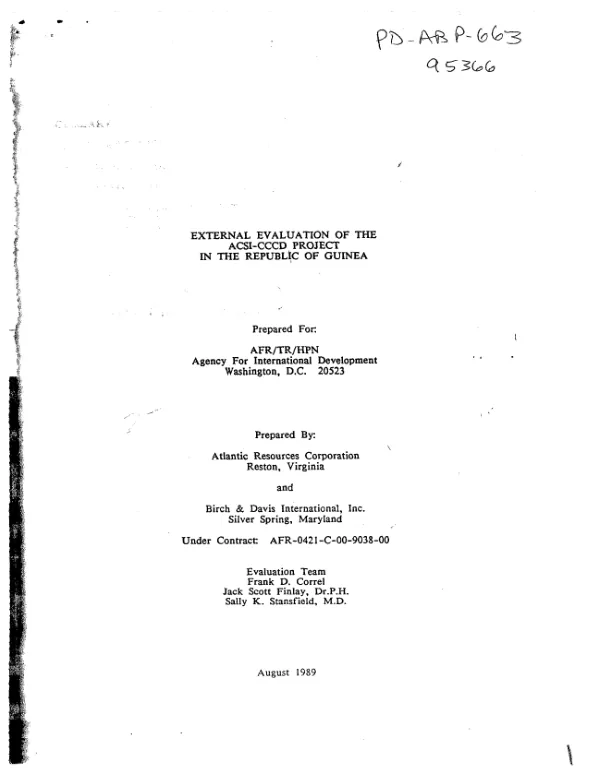
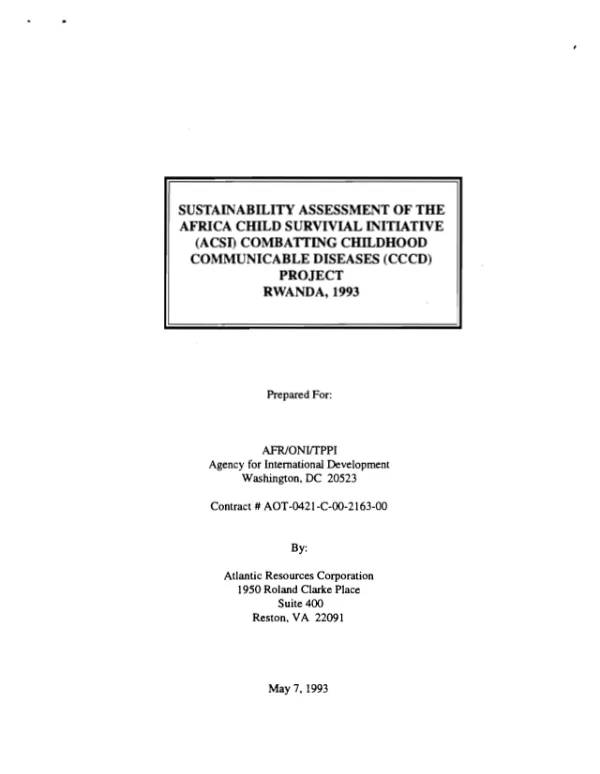
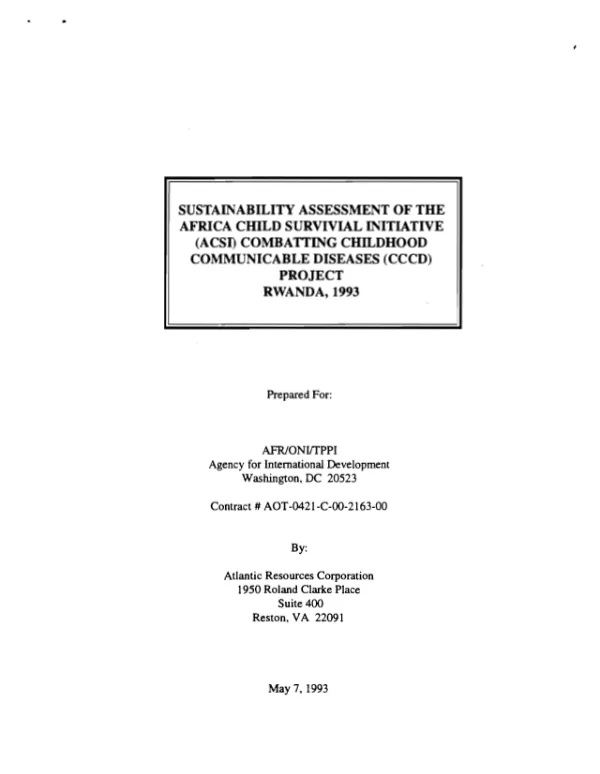
Sustainability assessment of the Africa child survival initiative (ACSI) : combatting childhood communicable diseases (CCCD) project, Rwanda, 1993
Sign inATLANTIC RESOURCES CORP.
Sustainability assessment of the Africa child survival initiative (ACSI) : combatting childhood communicable diseases (CCCD) project, Rwanda, 1993
Four years after the completion of A.I.D.'s Combatting Childhood Communicable Diseases project in Rwanda, a team of health professionals evaluated the project's sustainability, assessing over 50 indicators on the basis of six criteria: (1) perceived effectiveness; (2) integration and institutional strengthening; (3) local financing, community participation, and private sector provision of services; (4) training; (5) constituency building; and (6) local ownership.
1993
Sign in to readA free account is required to download.
Abstract
It was found that there is a strong national commitment to continue project activities, and that the activities are well integrated into public and private health structures. It was unanimous among Ministry of Health (MOH) staff and participating donors that the project was needed and effective and that it achieved most of its objectives. On a scale of 0 to 3, Expanded Program on Immunization (EPI) and Training/Supervision were judged to be the most sustained of the project's seven support strategies and interventions, with a score of 3 (permanent activity with improved quality), while diarrheal disease control and health education rated a 2 (permanent activity with maintenance of quality), and malaria control and health information systems a 1 (permanent activity with a decline in quality). Only operations research rated a 0 (it was not sustained). Lessons learned included the following. (1) Many public sector health professionals are leaving for the more rewarding private sector, thus jeopardizing sustainability. (2) Priority programs like EPI -- which has the highest status in the MOH and is the most organized -- perform better at all levels. (3) Health personnel motivation, e.g., financial incentives, is essential to program success and sustainability. Unfortunately, these incentives, currently being paid by UNICEF and the World Bank, will end with the phase-out of their projects.
Related documents
Documents in this collection
 1993
1993USAID DEC
Sustainability assessment of the Africa child survival initiative (ACSI) : combatting childhood communicable diseases (CCCD) project, Rwanda, 1993
Open record 1993
1993USAID DEC
![[Development Fund for Africa --] impact of child survival activities in Africa : a report on AID's progress in reducing infant and child mortality and illness in 17 child survival priority countries](https://covers.devme.ai/gen/8905.webp)