USAID DEC
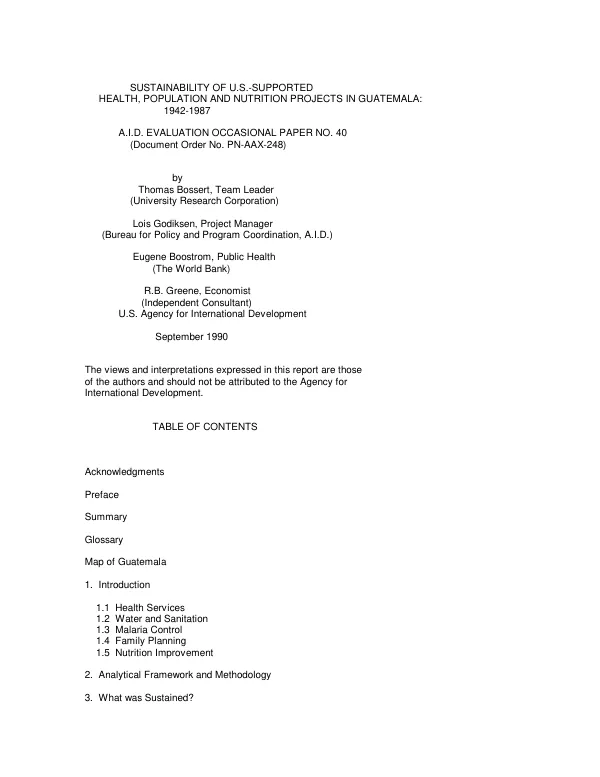
Sustainability of US supported health, population, and nutrition projects in Guatemala : 1942-1987
Sign inUSAID. BUR. FOR PROGRAM AND POLICY COORDINATION. CENTER FOR DEVELOPMENT INFORMATION AND EVALUATION (CDIE)
Sustainability of US supported health, population, and nutrition projects in Guatemala : 1942-1987
Since 1942, A.I.D.
Bossert, Thomas|Godiksen, Lois · 1990
Sign in to readA free account is required to download.
Abstract
and its predecessor agencies have funded 19 major health-related projects in Guatemala in five areas: health services, water sanitation, malaria control, family planning, and nutrition. These projects have brought significant and in many cases sustained benefits to the country. This report identifies two kinds of factors affecting project sustainability -- contextual factors, i.e., those beyond the control of project designers and managers, and project characteristics. In regard to contextual factors, national commitment to project goals and support from influential groups had positive impacts on sustainability, whereas the inadequacies of the implementing institutions (in terms of fragmentation, conflicting goals, and poorly trained staff) had an adverse influence. Sociocultural differences adversely affected sustainability when they were not taken into account, and had a positive influence when they were. Other contextual factors, such as natural disasters, political environment, U.S.-Guatemalan relations, economic changes, the private sector, and donor coordination, seemed to have little impact on sustainability. Project characteristics important to sustainability included: visibly effective achievement of project goals, integration of the project into the structure of the implementing agency, qualified and stable leadership from both the implementing agency and A.I.D., ability to provide for progressive absorption of recurrent costs, provision of significant professional or paraprofessional training and technical assistance, and cooperation between A.I.D. and the Guatemalan Government in project design. Project characteristics which did not seem important for sustainability include: foreign exchange demand, cost recovery, cost-effectiveness, appropriate technology, and community participation. Policy implications are presented in conclusion.