USAID DEC
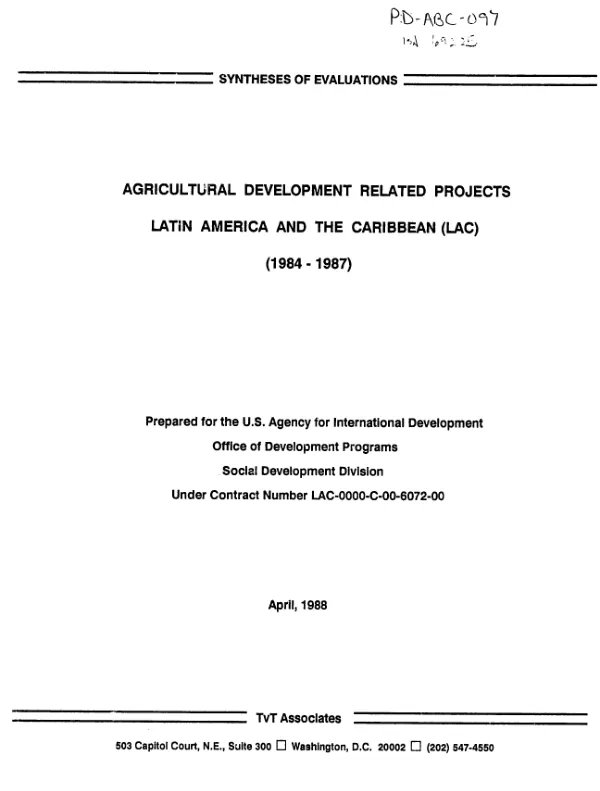
Syntheses of evaluations : agricultural development related projects -- Latin America and the Caribbean (LAC) (1984-1987)
Sign inTVT ASSOCIATES
Syntheses of evaluations : agricultural development related projects -- Latin America and the Caribbean (LAC) (1984-1987)
Synthesizes evaluations of 33 agricultural and rural development projects in the Latin American and Caribbean region, including projects in Belize, Bolivia, Costa Rica, Dominican Republic, Ecuador, El Salvador, Guatemala, Haiti, Honduras, Jamaica, Panama, Peru, Dominica, and Saint Vincent.
van Tijn, David E.|Brown, Vincent W.|Cohn, Gerald M. · 1988
Sign in to readA free account is required to download.
Abstract
The evaluations included both interim and final evaluations, were carried out over the period 1984-1987, and represented projects totaling $36 million in A.I.D. investments. Eleven major lessons were learned from the projects. (1) Crop diversification/export promotion activities must consider marketing as well as production, so that farmers who have successfully grown the new product will have a way to market it and pay back production loans. (2) Agricultural research projects, particularly farming systems research, require strong association with extension services for success. (3) Projects which utilize already functioning local organizations have tended to progress faster than those which use newly established organizations. (4) Projects containing both loan and grant components appeared well-designed and performed well, considering the complexity of tasks. (5) Local and international PVO's have been particularly successful in carrying out grassroots projects, e.g., community development activities. (6) Full government support is necessary in almost all projects, even those involved in the private sector. Where this support was lacking or where changes of administration diminished earlier cooperation, projects were delayed. (7) Projects in which several government ministries, PVO's, and/or other private and public agencies all share implementation responsibility require special care in delineating planning and operational responsibilities. In some cases it is better to make one ministry completely responsible for coordination and for all project funding, thus providing leverage with the other participating organizations. (8) Finding competent local project managers and qualified foreign advisors and keeping qualified local managers and technicians from leaving after training is completed has presented significant problems in a number of projects. (9) Project designs sometimes cover too many activities or areas, are too casual about the relationship of inputs to outputs, and have unrealistic timeframes. (10) Evaluation and monitoring provisions in project design need specific indicators (baseline data or specific targets) to measure progress. (11) Scopes of work for evaluation teams should be specific, laying out points of special interest to A.I.D. and the host government.