USAID. BUR. FOR PROGRAM AND POLICY COORDINATION. CENTER FOR DEVELOPMENT INFORMATION AND EVALUATION (CDIE)
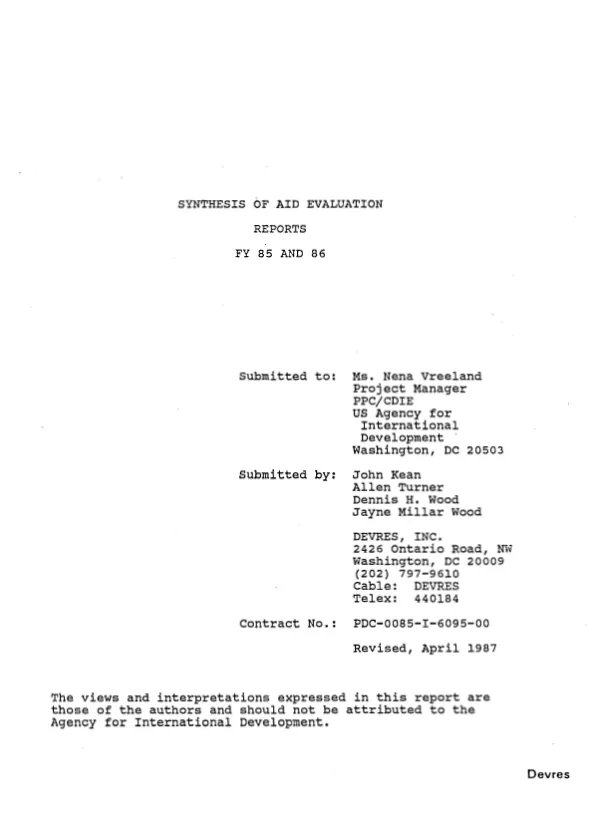
Synthesis of A.I.D. evaluation reports : FY 1985 and FY 1986
A comprehensive review of 212 evaluation reports (ERs) from FY 1985 and 1986, this document focuses on five key topics (implementation constraints, sustainability, women in development, environmental impacts, and private sector initiatives) in order to provide a distillation of recent experience and to identify patterns of both problems and successes.
Kean, John; Turner, Allen · 1988
Sign in to readA free account is required to download.
Abstract
The document uses a rating system to assess the significance of about 40 subtopics related to the five topics mentioned above. Findings are as follows. (1) Implementation constraints. About a third of the ERs reported that project design and adequacy of borrower/grantee staffing and budgeting were severe constraints to implementation success; projects with minimal implementation constraints were associated with strong management, well defined roles, relationships and responsibilities in project design, and activities that addressed needs clearly perceived by participants and beneficiaries. (2) Sustainability. Good project sustainability was associated most with positive ratings for technology acceptance (31%) and strength of project constituency and host country policies (24% and 21%). Poor sustainability was associated with negative ratings for organizational/institutional capacity, for financial provision for operation and maintenance, and for management capacity. (3) Women in Development. WID was a major purpose in about 15% of the projects. Successful projects tended to have positive ratings for strengthening locally based women"s institutions, including women as participants in project design/planning, and extending services for women into rural areas. (4) Environment. About 29% of the ERs made some sort of statement about environmental impact. Typically, high-rated environmental projects were associated with strong institution building components and the provision of medium-term economic motivation for improved resource management. (5) Private sector. About 21% of the ERs were concerned with private enterprise development. Key findings in this area included (inter alia): many A.I.D. projects are not designed explicitly to achieve certain desired impacts (e.g., employment creation); evaluation procedures are not adequate to capture the failure of projects to generate such desired impacts, and quality of design received the highest percentage of strongly negative ratings for private enterprise projects. Includes five annexes describing in detail the study"s methodology.