HARVARD UNIVERSITY. HARVARD INSTITUTE FOR INTERNATIONAL DEVELOPMENT (HIID)
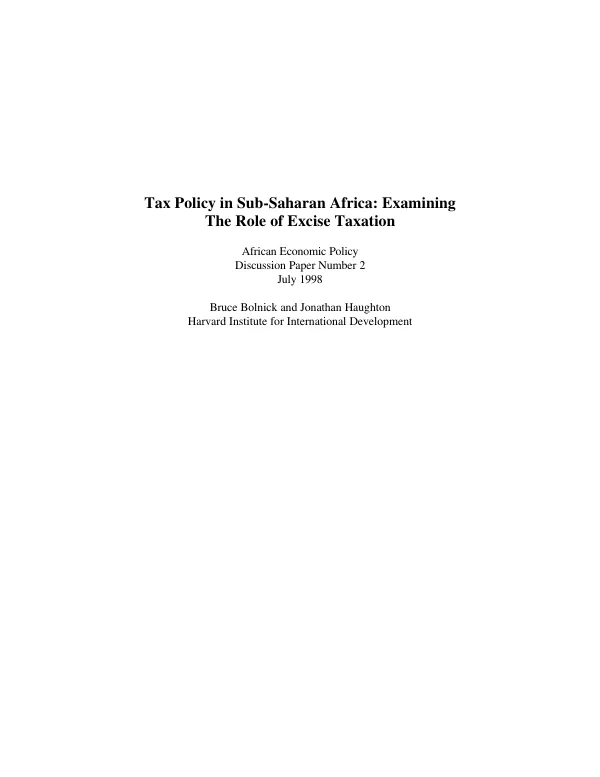
Tax policy in sub-Saharan Africa : examining the role of excise taxation
Excise taxes, notably on tobacco and petroleum products and on alcoholic beverages, raise revenue equivalent to 1.9% of gross domestic product in sub-Saharan Africa.
Bolnick, Bruce; Haughton, Jonathan · 1998
Sign in to readA free account is required to download.
Abstract
Their importance varies widely and inexplicably across countries, and shows no trend over time. In principle, excise taxes are good revenue sources, cheap to administer and potentially efficient, especially when applied to goods that cause negative externalities or face price-inelastic demand. Excises are consistent with a fair tax system, and complement broadly based taxes such as the value added tax. Excise taxes have, however, been largely ignored in the professional literature on developing countries. This article begins to redress this imbalance by asking what role excises do, and should, play in the countries of Sub-Saharan Africa. The paper formulates five propositions: (1) Revenue from excise taxes could and should be doubled in most African countries. (2) Considerable scope exists for efficiency- enhancing changes in the structure of excise taxes. (3) Excise taxes should be confined to the traditional excises and a limited number of luxury items. (4) Excise tax administration could be substantially improved by codifying and disseminating current best practices within sub-Saharan Africa. (5) Increased reliance on excise taxes is consistent with an equitable tax system. These propositions are necessarily tentative, because large gaps in our knowledge of excises in developing countries remain -- about demand elasticities, the extent of externalities, equity effects, administrative and compliance costs, and best practices. These gaps need to be filled before one can confidently advocate greater reliance on excises. (Author abstract)