MANAGEMENT SCIENCES FOR HEALTH
TB CARE Annual Work Plan and Budget
Afghanistan's tuberculosis (TB) control efforts received significant support from the Challenge TB (CTB) program during the second quarter of 2016.
2016 · 49 pages
Sign in to readA free account is required to download.
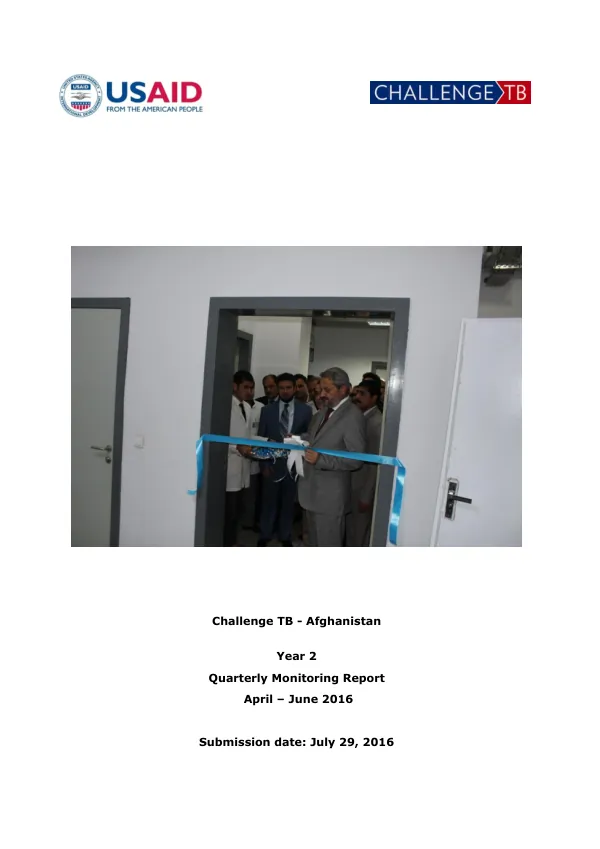
Abstract
The program, led by Management Sciences for Health (MSH), aimed to increase access to TB services for vulnerable populations, including children. Digital X-ray machines were installed in three children's hospitals in Mazar e Sharif, Herat, and Kandahar, providing improved diagnostic capabilities for TB. The machines were inaugurated by His Excellency, Dr. Ferouzudin Feruz, the Minister of Public Health, in a ceremony attended by Dr. Shersha from the USAID mission in Kabul. The digital X-ray machines are expected to benefit at least 10,000 children and diagnose several TB cases among them. The CTB program also contributed to improved TB case notification and treatment success rates in Afghanistan. In 15 intervention provinces, 51,987 presumptive TB cases were identified and examined for acid-fast bacilli, resulting in a 10% increase in case notification for all forms of TB and a 14% increase in bacteriologically confirmed TB cases. Since April 2016, in CTB intervention areas, 6,767 TB cases of all forms were notified, and 3,201 cases of bacteriologically confirmed TB were notified. The program also assisted the National Tuberculosis Program (NTP) in improving TB treatment success rates. The assistance included ensuring that follow-up examinations were conducted and that TB patients received their treatment as per the schedule. As a result, the treatment success rate in CTB intervention provinces was sustained at 89% (2,555/2,876; April-June 2015 cohort). Urban DOTS implementation was also a key focus area for the CTB program. In the densely populated areas of Kabul, Mazar, Herat, Jalalabad, and Kandahar, CTB helped NTP expand DOTS to 10 public and private health facilities, bringing the total number of Urban DOTS health facilities to 166 by the end of June 2016. CTB trained 159 health care staff members to follow standard operation procedures for TB case findings and treatment, including laboratory assessment and microscope repair and maintenance. The efforts of CTB and NTP led to a 28% increase in TB case notification in Kabul during the second quarter of 2016 compared to the previous quarter. The treatment success rate in Kabul was 76%, and one of the continued challenges was the high transfer rate of 15% compared to the national rate of 5%. CTB has strived to address this challenge by creating strategies to minimize transferring and improve the cure and treatment success rate. In addition, the CTB program supported the provision of TB services in two prisons, Pul-i-Charkhi-Kabul and Bagram. These prisons provided a full package of TB services, and the success rate of new bacteriologically confirmed TB patients was higher than the national level (93%) and national treatment success rate was 89%.