USAID DEC
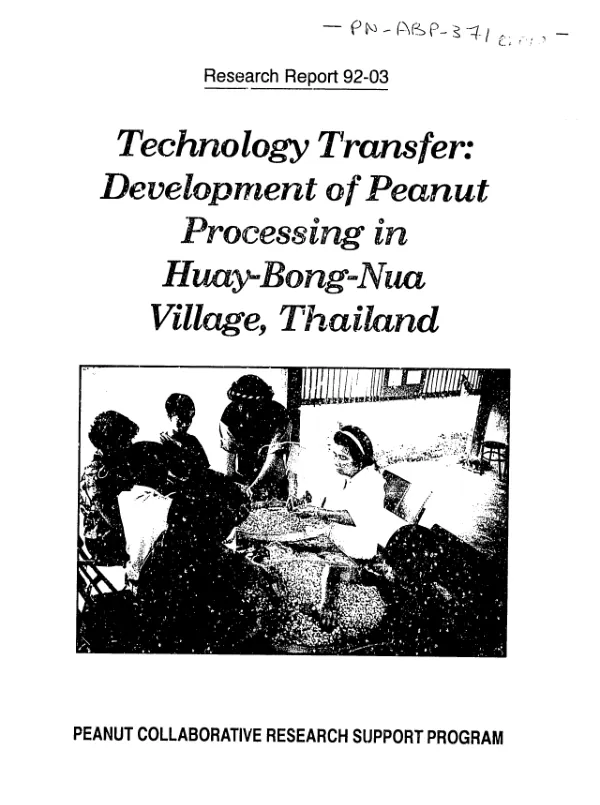
Technology transfer : development of peanut processing in Huay-Bong-Nua Village, Thailand
Sign inMICHIGAN STATE UNIVERSITY
Technology transfer : development of peanut processing in Huay-Bong-Nua Village, Thailand
This research, conducted from 1991-92, investigates the transfer of peanut processing technology, along with business and marketing management, to farmers in Huay-Bong-Nua village, Prao district, Cheingmai province, northern Thailand.
Haruthaithanasan, V.; Wattanatchariya, W. · 1992
Sign in to readA free account is required to download.
Abstract
Certain preliminary results (inconclusive due to the short time period) are inferred regarding the impact of this technology on the socioeconomic status of farmers. A pilot group of seven women farmers was formed to process peanut products for the downtown Cheingmai and Prao district markets. All necessary equipment and materials were purchased and set up at the project site. The women were trained in techniques for processing and quality control of both oil roasted and ground roasted peanut, as well as in business management and product marketing (oil roasted peanut is partially dry roasted, then completed in hot oil, while ground roasted peanut is dry roasted, then ground into flour). On-site activities were monitored monthly, thus providing a means for discussing and solving any problems that might arise. The quality of the products processed was evaluated before shipping to market and shelf life was determined. Finally, a socioeconomic evaluation of the group was initiated. The processed peanut products contained no aflatoxin, no defects, and low microbial contamination. Consumer acceptance of both products was high, especially of the ground roasted peanut which had better quality than others already available in the markets. These results revealed that the women were well-trained and understood the techniques for processing both oil roasted and ground roasted peanut. The shelf life of both products was short, however, about six weeks for oil roasted peanut and four weeks for ground roasted peanut. High temperatures and unsuitable packaging caused the products to become rancid, which resulted in product rejection. Total cost for oil roasted peanut was 43.44 Bahts/kg and for ground roasted peanut 17.20 Bahts/kg. Retail price for oil roasted peanut was 100 Bahts/kg and for ground roasted peanut 30 Bahts/kg. Commission to shopowners was 20% of the retail price. Net profit was 36.66 Bahts/ka for oil roasted peanut and 6.80 Bahts/kg for ground roasted peanut. Because of the demand for and turnover rate of the flour, it is recommended that farmers concentrate on processing ground roasted peanut. Improvement in socioeconomic status of the producer group appears promising, although the project was conducted for only six months, a short time for definitive change. Nevertheless, the women learned techniques for processing peanut products, business management, and marketing management, all of which will help them improve their quality of living. In fact, during the six months following the end of the project, the group of women earned a monthly profit of at least 1,088 Bahts by selling ground roasted peanut in the Prao district market alone. Note: This report uses the local terms rai for land and Baht for money throughout. For comparison: 6.25 rai = 1 ha; 2.5 rai = 1 acre; 25 Bahts = $1.00 U.S (Author abstract)