USAID DEC
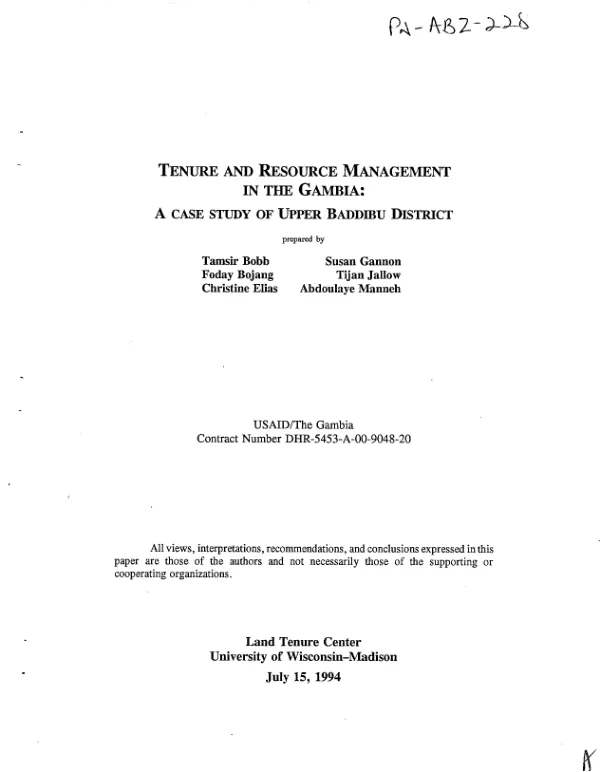
Tenure and resource management in The Gambia : a case study of Upper Baddibu District
Sign inUNIVERSITY OF WISCONSIN AT MADISON. LAND TENURE CENTER (LTC)
Tenure and resource management in The Gambia : a case study of Upper Baddibu District
This case study, conducted from 5/28/93-6/26/93, investigates the relationship between customary tenure relations, statutory law, and natural resource management practices in the Upper Baddibu District of the Gambia.
Bobb, Tamsir; Gannon, Susan · 1994
Sign in to readA free account is required to download.
Abstract
Traditional tenure arrangements appear to be adequately flexible in responding to the needs of the populations of the Upper Baddibu District; for example, in Maka Farafenni village, most land disputes are resolved at the household level, with relatively few reaching the alkalo. However, in some cases (e.g., Dutabulu) the regimes do not respond to the requirements of the population. There are differences in the ways in which user groups perceive and utilize natural resources. Government policy and development interventions should consider these differences when developing policies and projects. Participants in the case study had very strong ideas about how they would resolve the problems affecting their livelihood strategies, but lacked knowledge of their rights to natural resources and lacked technical information concerning resource management. This highlights the need for environmental education and extension programs on all levels. In conclusion, further research on tenure issues and the development of solutions to the resource management problems facing the study population is imperative. The close collaboration of communities and government in determining resource management plans is a critical element in the process. Includes bibliography. (Author abstract)