USAID DEC
TERMINAL REVIEW OF THE PROGRAM "RESEARCH IN ARTIFICIAL PROPAGATION OF MILKFISH" CONDUCTED AT THE OCEANIC INSTITUTE
Sign inUSAID. BUR. FOR DEVELOPMENT SUPPORT. OFC. OF AGRICULTURE
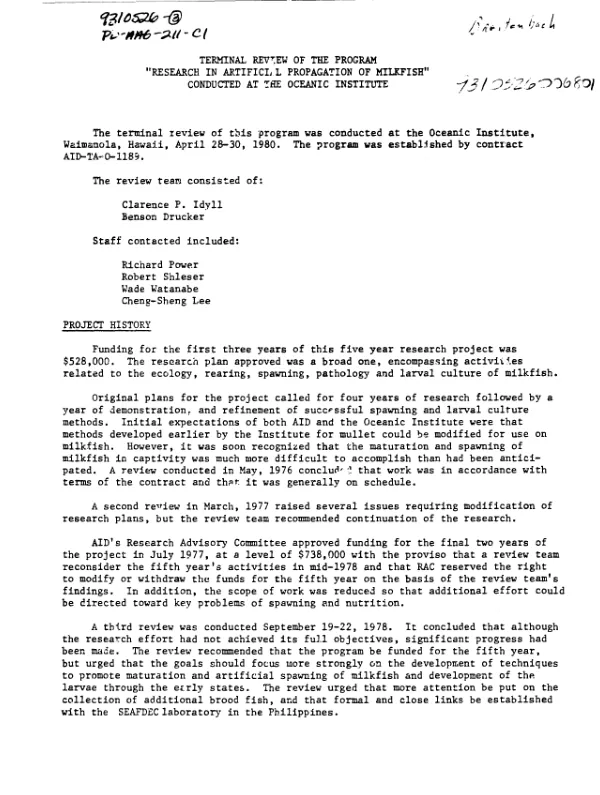
TERMINAL REVIEW OF THE PROGRAM "RESEARCH IN ARTIFICIAL PROPAGATION OF MILKFISH" CONDUCTED AT THE OCEANIC INSTITUTE
Evaluates project to develop an effective means of supplying young milkfish to commercial farmers in Southeast Asia.
IDYLL, CLARENCE P.; DRUCKER, BENSON · 1980
Sign in to readA free account is required to download.
Abstract
This terminal evaluation is based on a two-day, onsite review at the Oceanic Institute (OI) at Waimanola, Hawaii. Both A.I.D. and OI expected that methods developed earlier by OI for mullet could be modified for use on milkfish. However, this expectation proved wrong. The maturation and spawning of milkfish in captivity is much more difficult than mullet -- milkfish are easily distressed and their reproductive physiology is more complicated. As a result, a lack of brood animals proved to be an overwhelming obstacle. For example, of 77 brood animals available in 1977, only six were found to be in proper reproductive condition for experimentation. Spawning efforts in the Philippines might have been successful if more fish had been available -- and if a typhoon had not destroyed traps used to supply brood stock. However, OI researchers made progress in the use of hormone injections to induce spawning, and successfully identified the stage of ovarian development at which the oocytes are responsive to exogenous hormone treatment. Also, later project experiments suggested that milkfish sperm can be stored for considerable periods and still be effective. Overall, OI"s performance was satisfactory and its personnel well-qualified. Technical and fiscal reports were submitted on time. Coordination with other institutions was extensive, and included contact with the Southeast Asia Fisheries Development Center (SEAFDEC), French Polynesia, and Taiwan. Management problems included: too many and too varied research activities, thus preventing sufficient attention to problem areas; misunderstandings with SEAFDEC personnel earlier in the project; and logistical bottlenecks -- a lack of vehicles, fuel, and tanks, and male fish ready for breeding. This report is attached to a PES (PD-AAG-211-B1).