USAID DEC
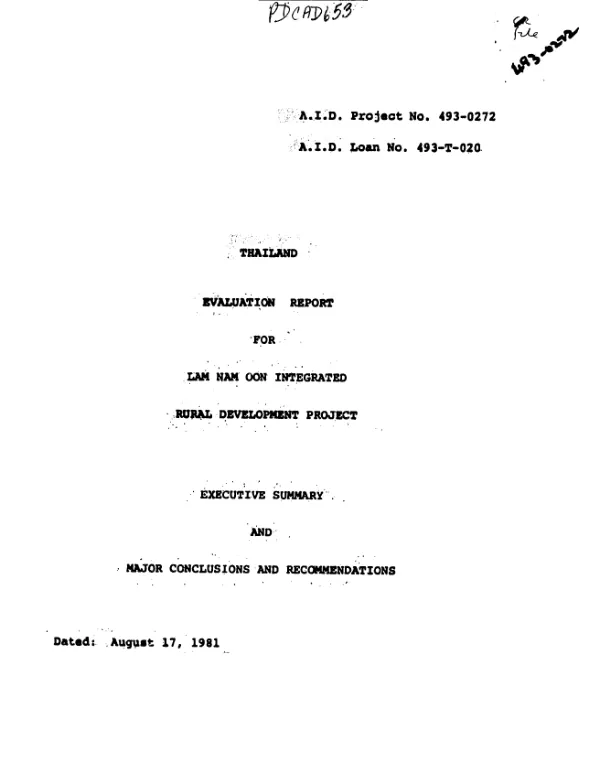
Thailand : evaluation report for Lam Nam Oon integrated rural development project, executive summary and major conclusions and recommendations
Sign inUSAID. MISSION TO THAILAND
Thailand : evaluation report for Lam Nam Oon integrated rural development project, executive summary and major conclusions and recommendations
Evaluates irrigation and integrated rural development project in Lam Nam Oon in northeast Thailand.
Schoux, William|Muscat, Robert · 1981
Sign in to readA free account is required to download.
Abstract
Special joint evaluation covers the period 1/78-8/81 and is based on document review, site visits, and interviews with staff, beneficiaries, and Royal Thai Government (RTG) officials. The project is beset by serious economic, physical, and management problems. It will not produce sufficient return on investment to cover costs; even if the $50 million "sunk cost" is excluded from calculations, returns will be inadequate unless lower-cost methods of on-farm water development are used in the future. The project's physical problems, such as deteriorated canal linings and eroded side slopes, are the result of poor design, inadequate construction, and lack of resources for proper maintenance or failure to use these resources effectively. If the system is not improved, it will not be able to deliver a sufficient water supply to an expanded number of farmers. In addition, a large-scale, extremely costly land clearing and leveling technique which is detrimental to the area's thin topsoil is in use, although alternative techniques are available. Managerial deficiencies - e.g., poor intra- and interagency coordination, failure to help project staff to enlist farmer participation in irrigation system construction and maintenance - appear to result primarily from inadequate management information systems and ineffective organizational arrangements. Nonetheless, it should be noted that the project's integrated approach has engendered an unprecedented level of cooperation among RTG agencies. The project has had some positive results. A groundnut price support program has led to production of the crop by 2,000 farmers. Also, the majority of farmers with access to reliable irrigation did cultivate at least part of their land during the past dry season. Although RTG officials are aware of the project's problems - many are shared with other irrigation sites in the northeast - no systematic approach to dealing with them has been taken. Included are several recommendations, six of which are considered essential to project continuation.
Related documents