DEVELOPMENT SCIENCES, INC.
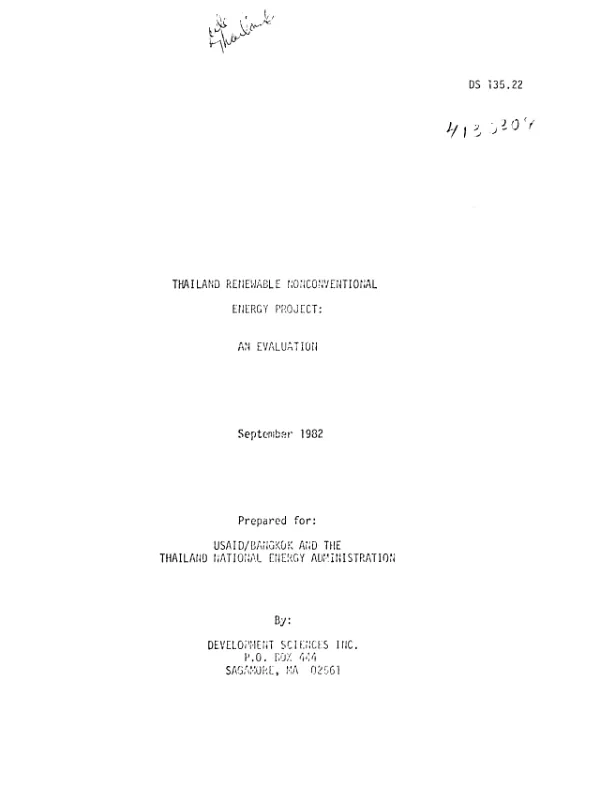
Thailand renewable nonconventional energy project : an evaluation
Evaluates project to assess the applicability of a host of renewable nonconventional energy technologies for use in rural Thailand.
1982
Sign in to readA free account is required to download.
Abstract
Special evaluation covers the period 8/79- 9/82 and is based on document review, site visits, and interviews with project personnel and with specialists in renewable energy development in Thailand. While some progress has been made, implementation of most of the project's 14 components only began in mid-1982 (following long delays in contracting and preparation of workplans) and will probably not be completed within the project timeframe. The project is overambitious (both as a whole and with regard to individual components), and planning remains deficient (component workplans are insufficiently detailed, no overall workplan exists, and planning in other areas - e.g., for technology dissemination and assessment, for handling components not completed by project end - has been inadequate). The composition of the project has changed frequently and is still experiencing minor changes. Most of the planned energy resource assessments have been eliminated; only the solar and wind assessment remains, and this in curtailed form. Project training has been cut drastically, and there may be no long-term academic training. Also, some new technologies (gasification, industrial biogas) have replaced those originally planned (industrial conservation, conversion system integration). It is suggested that a solar pond component be considered, and the utility of the micro hydro, survey, and energy master planning assistance components be reassessed. Although there has been some divergence among A.I.D., the National Energy Administration of Thailand, and some component leaders as to how the project is viewed, management and coordination have improved over the last year, mainly as a result of quarterly workshops. The roles of all participants need to be redefined, and agreement must be sought as to the amount, nature, and origin of TA. Despite the project's problems, its goals for the most part remain valid and in some areas there has been signficant progress. Provided are a series of recommendations which if adopted will allow the project to complete its objectives on time and within budget.