THE FUTURES GROUP INTERNATIONAL, INC. (TFGI)
The condom social marketing component of the HIV/AIDS prevention project (HAPP)
Final evaluation of the contraceptive social marketing (CSM) component of the HIV/AIDS prevention project (HAPP) in Indonesia (1998-2000).
2000
Sign in to readA free account is required to download.
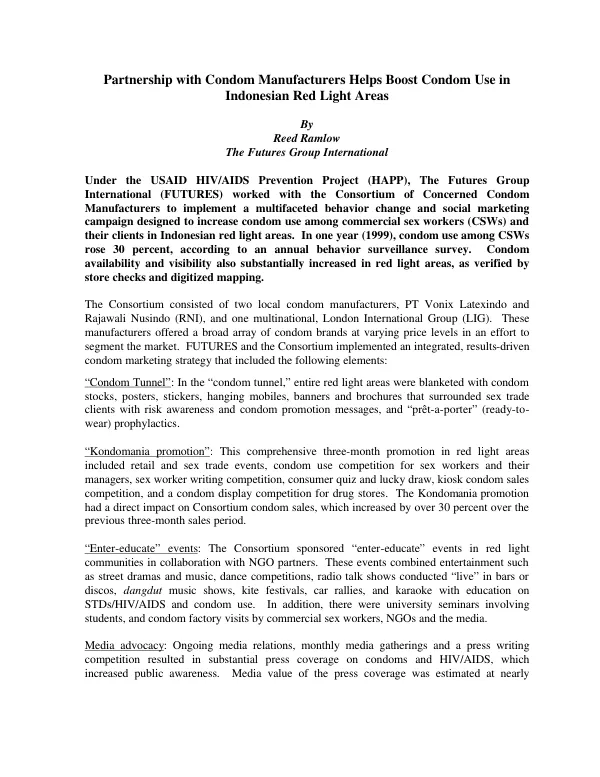
Abstract
The Futures Group was the lead implementing entity. CSM efforts to popularize condoms and increase demand for condoms by commercial sex workers (CSWs) had positive impact. According to a 1999 survey, condom use by CSWs rose significantly in Jakarta, Surabaya, and Manado; condom use among male clients also rose in 1999. Awareness among CSWs that condoms prevent HIV/AIDS increased from 70% in 1996 to 84% in 1999. Increasing condom sales for the private commercial sector has been difficult due to the DKT-Sutra subsidy intervention and the ongoing economic crisis. In 1999, combined condom sales by consortium manufacturers rose 10% in HAPP demonstration areas First half 2000 sales are up 14% in these areas. The overall condom market shows very encouraging growth. The 2000 store check results indicated a slight increase in condom availability over 1999. with 65% aggregate penetration in the three demonstration areas. In 2000, penetration slightly dropped in Jakarta due to the late 1999 closure of the Kramat Tunggak red light area. Penetration on the other hand slightly increased in Surabaya, which may be reaching the saturation point in terms of outlet penetration potential, and significantly increased in Manado. The success in expanding coverage to non-traditional outlets such as kiosks and brothels is attributable to special sales task forces fielded by the consortium (with HAPP support) and DKT (with German government support). Condom distribution patterns in non-traditional outlets will likely track the movement of red light areas. Futures submits that achieving and maintaining condom coverage in 65% of all outlets is a commendable achievement and may represent a saturation point. Condom sales cannot approach the sales volumes of fast-moving consumer goods such as cigarettes and snacks. Indeed, since there will likely be a high drop-out rate among non-traditional outlets for condoms, demand generation activities become very important in maintaining non-traditional outlets for condoms. (Traditional outlets such as pharmacies and supermarkets still account for the lion"s share of condom sales.) Futures maintains that condom availability is excellent in the HAPP demonstration areas, particularly in "localization" areas, and that lack of access does not entail a significant barrier to condom use in these areas. In the public relations and media relations programs, in 1999 media relations generated 40 articles on HIV/AIDS and 9 articles mentioning condoms per week among 70 media publications in Indonesia. In 2000, there has been a weekly average of 25 articles on HIV/AIDS and 4 articles mentioning condoms. In both 1999 and 2000 Futures and HAPP aired 3-month public service advertising (PSA) television campaigns promoting condoms -- a landmark achievement in Indonesia given prior restraints on even mentioning the word "condom", even in internal project documents. Retail audit results suggest that the TV campaign has had a strong impact on condom sales. Futures also aired various radio campaigns. One- quarter of the men surveyed in the 2000 KAP study recalled the most recent radio campaign that featured a disco jingle on ways to prevent HIV/AIDS, including condom use. The private commercial sector"s committed response and vigorous participation helped ensure the cost-effectiveness and sustainability of the CSM component. This participation set the CSM program apart from the highly subsidized DKT CSM intervention and from government and NGO HIV/AIDS programs that heavily rely on donor support. It is important to note that the consortium members contributed non-subsidized packaged condoms and met their own personnel, overhead, and operating costs. They also contributed the numerous sales personnel of their distributors. Consortium members plan to sustain the task forces assigned to them to develop non-traditional outlets in red light areas in Jakarta, Surabaya, and Manado/Bitung following the termination of HAPP funding after June 2000 -- clear evidence that the CSM program generated sustainable private sector investment and commitment. Lessons learned are as follows: (1) It is in the private sector"s interest to: serve the mass market with products and prices to suit all socioeconomic classes, especially high- risk groups; increase access to its products; and shift the image of its condom products from negative to positive. (2) Mass media advertising helps de-stigmatize condoms, improves the selling and purchasing environment, and increases retail sales. (3) Public-private partnerships work, particularly in countries such as Indonesia that have a developed commercial sector. Such partnerships also offer cost-efficiencies, cost sharing, and sustainability. (4) The private sector will invest in disease prevention programs if it has incentives and the programs will generate returns, but not if it sees no market opportunity. (5) The DKT intervention threatens to de- motivate the commercial sector as the subsidized Sutra brand dominates the condom market and reaps most of the benefit from public sector support. This may lead to the disappearance of local condom brands from the market. Nonetheless, the private sector is inherently sustainable. (6) For-profit and non-profit entities can work together to support disease prevention programs if they have a perceived mutual benefit. The CSM effort showed this can be accomplished if there is a coordinating entity to bring the parties together.