USAID DEC
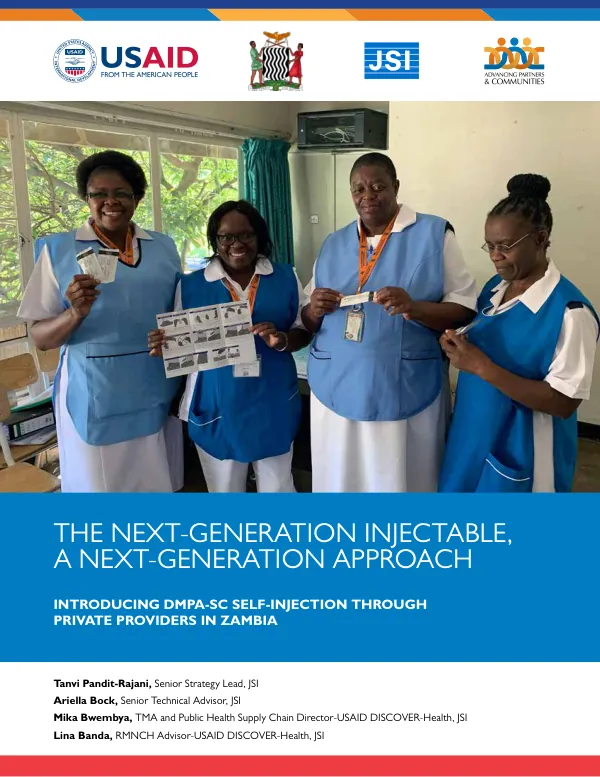
The Next Generation Injectable, A Next Generation Approach: Introducing DMPA-SC Self-Injection Through Private Providers in Zambia
Sign inFHI 360
The Next Generation Injectable, A Next Generation Approach: Introducing DMPA-SC Self-Injection Through Private Providers in Zambia
The DMPA-SC self-injection pilot in Zambia aimed to introduce and scale up the use of Sayana Press, a new-generation injectable contraceptive, through the private sector.
2019 · 41 pages
Sign in to readA free account is required to download.
Abstract
The pilot was designed to generate experience and inform country and global learning on the operational considerations of private provision of DMPA-SC self-injection. The primary objectives of the pilot were to understand experiences with a client-centered DMPA-SC self-injection training model and to identify health system relationships, barriers, and solutions for national scale-up in Zambia. The pilot was conducted in partnership with the Zambian Ministry of Health (MOH) and involved adapting and tailoring globally available DMPA-SC training materials and methodologies to a private sector setting. The client-centered approach reflected the specific needs and desires of private health sector clients and providers. The pilot aimed to understand clients' willingness to pay for the product and to identify health system relationships, barriers, and solutions for national scale-up. The pilot was part of a larger strategy to introduce and scale up DMPA-SC in Zambia, which called for private sector engagement. The Zambian MOH had initiated a strategy development process in 2018 to introduce and scale up DMPA-SC, and the pilot was designed to provide operational recommendations for policy and program planning. The pilot involved a range of stakeholders, including private health providers, clients, and government officials. The pilot was designed to be a phased approach, with the first phase focusing on training and capacity building for private health providers. The second phase involved the introduction of DMPA-SC self-injection services in private health facilities, and the third phase focused on scaling up the services to reach a wider audience. The pilot was supported by a range of partners, including the USAID DISCOVER-Health project, the Advancing Partners & Communities (APC) project, and the JSI Research & Training Institute, Inc. The pilot was also supported by the Zambian Ministry of Health and the private sector. The pilot aimed to provide a range of benefits, including increased access to family planning services, improved health outcomes, and increased economic opportunities for women. The pilot was also designed to contribute to the global knowledge base on the use of DMPA-SC self-injection in the private sector. The pilot was conducted in several districts in Zambia, including Lusaka, Copperbelt, and Eastern Province. The pilot involved a range of activities, including training and capacity building for private health providers, the introduction of DMPA-SC self-injection services in private health facilities, and the scaling up of services to reach a wider audience. The pilot was evaluated using a range of indicators, including the number of private health providers trained, the number of clients served, and the level of client satisfaction. The pilot was also evaluated using a range of qualitative methods, including interviews and focus group discussions. The pilot provided a range of recommendations for policy and program planning, including the need for increased investment in training and capacity building for private health providers, the need for improved access to DMPA-SC self-injection services, and the need for increased support for private sector engagement in family planning. The pilot also provided a range of lessons learned, including the importance of a client-centered approach, the need for tailored training and capacity building for private health providers, and the need for improved communication and coordination between government officials and private sector stakeholders. Overall, the DMPA-SC self-injection pilot in Zambia provided a range of benefits, including increased access to family planning services, improved health outcomes, and increased economic opportunities for women. The pilot also contributed to the global knowledge base on the use of DMPA-SC self-injection in the private sector and provided a range of recommendations for policy and program planning.