USAID. BUR. FOR PROGRAM AND POLICY COORDINATION. OFC. OF EVALUATION
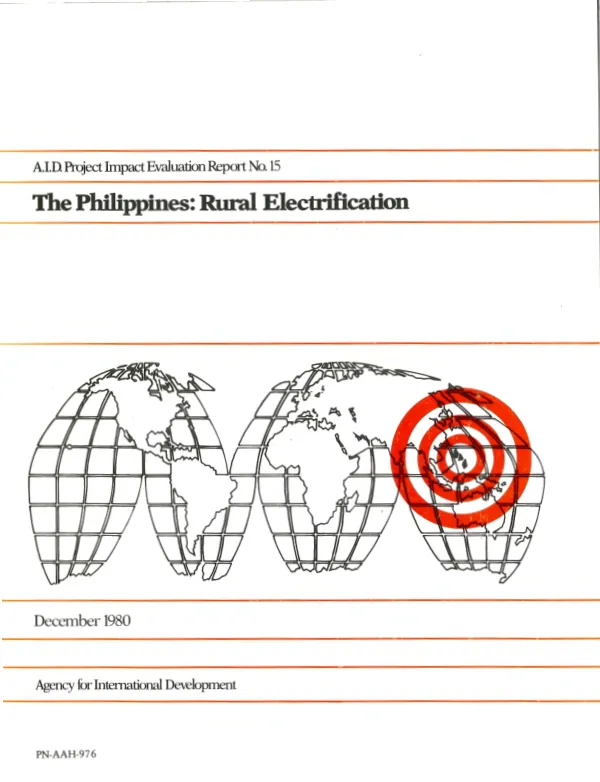
The Philippines : rural electrification
A.I.D."s overall evaluation of its Philippine Rural Electrification (RE) program, consisting of eight successive projects, noted that it has had limited effect on the rural poor and the economic development process.
Mandel, David H.; Allgeier, Peter F. +4 more · 1980
Sign in to readA free account is required to download.
Abstract
This program began in 1965 and has since energized 844 (59% of the national total) Philippine municipalities, 9,088 (27%) barrios, 1,159,434 (20%) households, and 101 new cooperatives; resulting in a change of schedule for total national energization from 1990 to 1987. To improve the productive capacity of the poor, cooperatives were organized and lent funds to extend electrical power into their areas. Many of the poor, however, could not afford its installation, continued use, or more than one or two light bulbs a month. Community lighting, such as street-lighting, indirectly helped the poor in various ways, such as by providing greater personal security. Those with sufficient financial resources or skills were able to use the electricity for entrepreneurial activities. RE impact upon development occurred in areas with a concentrated population, available technical skills and capital, and access to large and diverse markets. Active promotion of electricity-dependent investments and projects also increased program impact. Conclusions reached are: (1) Economic growth requires not only electricity, but also the development of power-oriented projects and programs. (2) Electrification must be complemented by development efforts aimed at the poor if it is to directly provide higher productivity levels, employment opportunities, and better public and social services. (3) The service natur of cooperatives requires that a high priority be given to effective management -- even at the expense of beneficiary participation or democratization of the development process. (4) Productive power use and slower expansion rates encourage the financial viability of RE systems. (5) Because of the availability of other fuels, RE does not greatly increase energy demand. Appended are the evaluation"s methodology, assessments of the financial viability and development potential of RE cooperatives, cooperative statistics, socioeconomic case studies, an energy impact statement, and a 23-item bibliography (1974-80).
Related documents