USAID. BUR. FOR POLICY AND PROGRAM COORDINATION
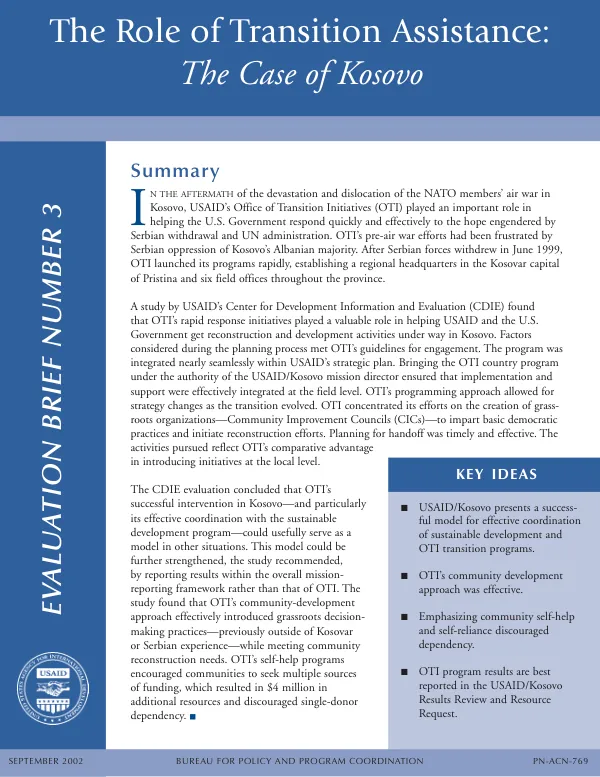
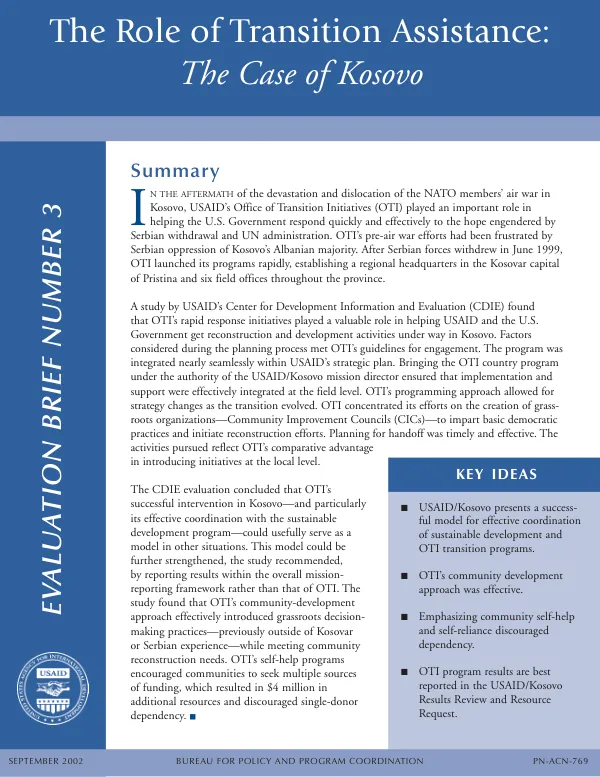
The role of transition assistance
This study, based in part on case studies in Indonesia, East Timor, Kosovo, and Nigeria, examines the role and activities of the USAID Office of Transition Assistance (OTI) in providing short-term assistance in the critical 2-year period after conflict, with a focus on program decisionmaking, planning, implementation, duration, and effectiveness.
DuRette, Jean · 2003
Sign in to readA free account is required to download.
Abstract
Simplified procedures, flexible funding, and rapid response characterize transition programs. Decisions to initiate transition programs involve the application of guidelines, an in-country assessment, and consultation with key USAID and other U.S. Government partners. Except for Honduras, which involved a natural disaster, OTI decisions regarding the 21 programs reviewed were generally consistent with the guidelines. The evaluation recommends that the questions be systematically documented for transparency. Program planning at the central level generally emphasized activity planning rather than strategic planning. It is recommended that the new OTI strategic plan identify objectives that are within its manageable interest and develop a performance monitoring system that tracks accomplishments systematically across programs. Although country-level planning of OTI programs is becoming more strategic, better integration of OTI country plans with mission country strategic plans could help avert the proliferation of objectives, enhance program complementarity, simplify performance monitoring, and better consolidate Agency performance reporting at the country level. Rapid, flexible action and experimentation characterized transition program implementation. Tailored procurement mechanisms -- e.g., a pool of consultants under flexible contracts ready for deployment as needed and a set of indefinite quantity contracts -- supported a rapid response. Integration of field operations support with that of the Missions enhanced program integration. OTI effectively coordinated its programs with its U.S. and donor partners at the field level, but coordination with regional bureau field missions showed a mixed record. Kosovo provides an effective model of coordination, but other case studies indicated communication and program coordination problems. Clearer Agency guidance on this score is recommended. Coordination at the field level was also mixed. The establishment of a separate central conflict office raises another area of potential duplication. Rationalization of the roles and responsibilities of OTI, the Office of Democracy and Governance, and the Office of Conflict Management and Mitigation could obviate duplication and better consolidate political development efforts. Most of OTI"s initial 21 programs have lasted 3 or more years, with several lasting 5 or 6 years. Inconsistent application of the stated 2-year policy created confusion among bureau and mission staff and affected the timeliness of program handoff. The evaluation calls for the Agency to clarify its policy on the duration of transition assistance. Three field activities showed especially promising results. The media strengthening initiative in Indonesia was visible, timely, and effective in supporting elections, helping develop a legal framework for media, and building NGO capacity to use media in accomplishing advocacy goals. The community development activity in Kosovo effectively introduced basic democratic processes at the grassroots level while helping war-devastated communities meet reconstruction needs. The conflict-management training initiative in Nigeria helped Nigerians mitigate or better manage a number of local conflicts. (Author abstract, modified)
Related documents
![Office of Transition Initiatives (OTI) : annual report [AR] FY 2002](https://covers.devme.ai/gen/61483.webp)