USAID. BUR. FOR POLICY AND PROGRAM COORDINATION
The role of transition assistance : the case of East Timor
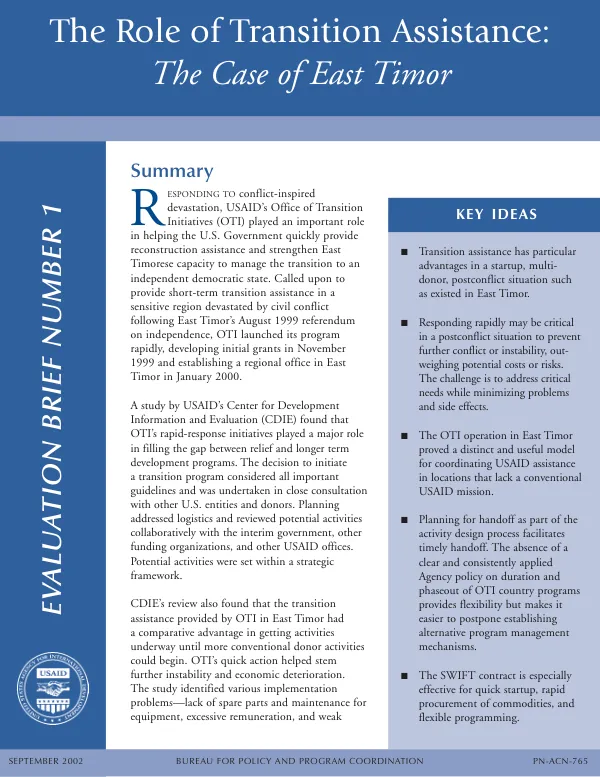
Called upon to provide short-term transition assistance in a sensitive region devastated by civil conflict following East Timor's August 1999 referendum on independence, USAID's Office of Transition Initiatives (OTI) launched a program rapidly, developing initial grants in November 1999 and establishing a regional office in East Timor in January 2000.
Furness, Brian R. · 2002
Sign in to readA free account is required to download.
Abstract
This study by USAID's Center for Development Information and Evaluation (CDIE) found that OTI's rapid-response initiatives played a major role in filling the gap between relief and longer term development programs. The decision to initiate a transition program considered all important guidelines and was undertaken in close consultation with other U.S. entities and donors. Planning addressed logistics and reviewed potential activities collaboratively with the interim government, other funding organizations, and other USAID offices. Potential activities were set within a strategic framework. CDIE's review also found that the transition assistance provided by OTI in East Timor had a comparative advantage in getting activities underway until more conventional donor activities could begin. OTI's quick action helped stem further instability and economic deterioration. The study identified various implementation problems -- lack of spare parts and maintenance for equipment, excessive remuneration, and weak partner organizations, but concluded that the need for fast action justified the risks. The Support Which Implements Fast Transitions (SWIFT) mechanism, an indefinite quantity contract, proved especially effective for program start-up, rapid procurement, and flexible programming. The study concluded that the East Timor intervention provided a successful model for USAID intervention in situations that do not call for establishing a conventional onsite mission. Continued slippage in OTI's exit date indicated problems in handing off transitional activities: despite planning for handoff, the lack of more permanent mechanisms for managing initiatives created pressure to retain OTI past its scheduled departure. Lack of a clear and consistent agency policy on transition program duration further hindered timely phase-out of OTI initiatives. (Author abstract, modified)
Related documents