USAID DEC
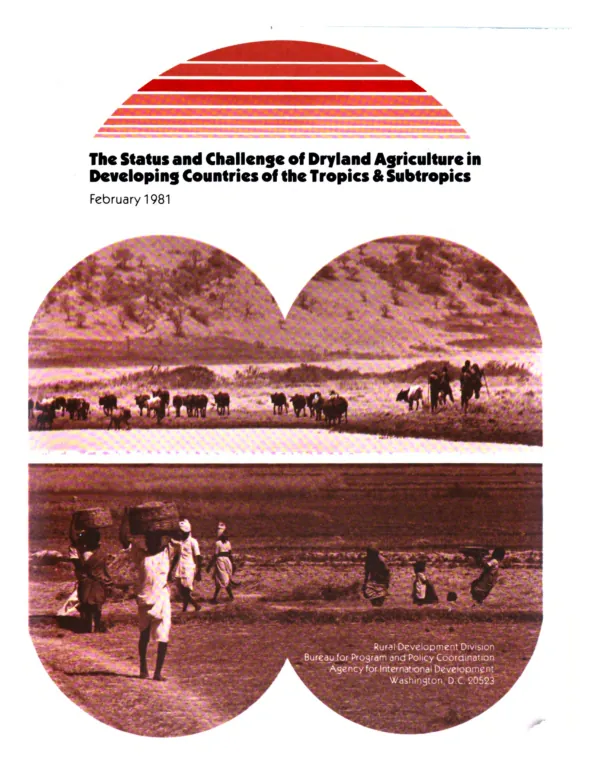
The status and challenge of dryland agriculture in developing countries of the tropics and subtropics
Sign inUSAID. BUR. FOR PROGRAM AND POLICY COORDINATION. OFC. OF POLICY DEVELOPMENT AND PROGRAM REVIEW
The status and challenge of dryland agriculture in developing countries of the tropics and subtropics
Increasing production in the dryland areas (areas having annual rainfall of 10-40 inches and dry seasons of 3-10 months) of tropical and subtropical developing countries is critically important in the quest to increase world food production.
Sprague, Howard B. · 1981
Sign in to readA free account is required to download.
Abstract
This paper highlights major approaches for using available technology more effectively toward this end. Land and soil attributes (e.g., topography and soil capability) that affect dryland agricultural production are described, as are the plant characteristics that permit the most effective uses of limited moisture and provide tolerance to extended periods of dryness. Crop rotations specifically suited for dryland areas and methods for improving farming systems are included. Among annual crops generally suitable for dryland farming, cereals, food grain legumes, oilseed crops, and fiber crops are most propitious in wet-dry tropical areas; forage crops are best in subhumid tropical areas; drought-resistant crops (pearl millet or grain sorghum) are good in semiarid tropical zones; and for the subtropical temperate Mediterranean zone, wheat, barley, chickpeas, and lentils are best in the cool season while sorghum, millet, beans, and cowpeas are best in the warm season. Included among criteria for acceptable farming systems are opportunities to improve net farm family income; diversity in types of farm/herd enterprises to cushion against losses; availability of labor, resources, and credit; contribution to improved long-range production; and provision of technical assistance. General requirements to improve dryland agricultural production include: (1) profitable returns for the hard-working farmer; (2) maps that identify land capability categories; (3) rational soil management which appropriately utilizes available resources and properly integrates livestock and cultivation enterprises; (4) a dependable supply of inputs; (5) competent extension officers; (6) field research stations; (7) commercial grades for marketable commodities; and (8) a national education system that emphasizes vocational agriculture and agricultural sciences. A list of botanical names for crop species is appended.
Related documents