USAID DEC
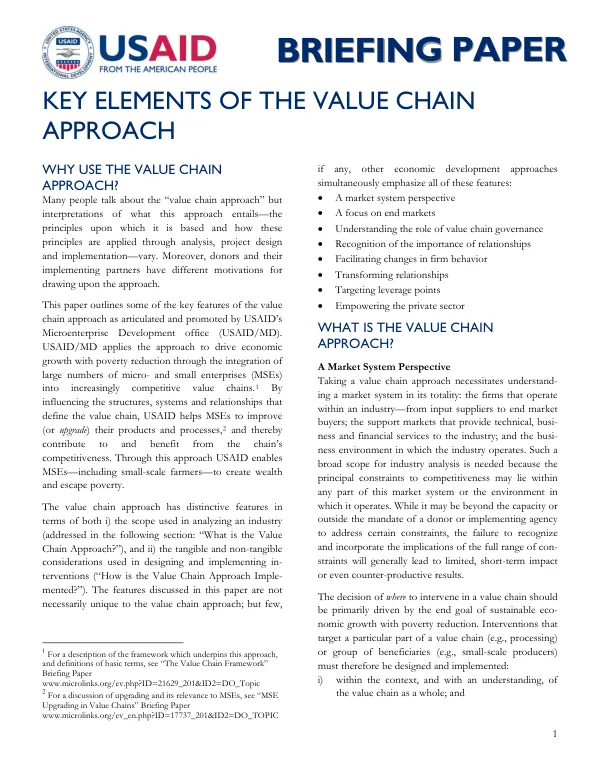
The Value Chain Approach: A Framework for Economic Growth with Poverty Reduction
The value chain approach is a market system perspective that necessitates understanding a market system in its entirety.
2009 · 4 pages
Sign in to readA free account is required to download.
Abstract
This broad scope is needed because the main constraints to competitiveness may lie within any part of the market system or the environment in which it operates. The decision on where to intervene in a value chain should be primarily driven by the end goal of economic growth with poverty reduction. A focus on end markets is essential, as they provide opportunities and set the parameters for economic growth. Multiple actual and potential end markets exist, each with different demand characteristics and returns. It is crucial to identify and benchmark key attributes such as quality, price, reliability, flexibility, and time from order to delivery against industry stakeholders to see where they have a competitive advantage and where they need to upgrade. Understanding the role of value chain governance is fundamental to the value chain approach. Value chain governance describes which firms within a value chain set and enforce parameters under which others in the chain operate. Embedded in value chain governance are inter-firm relationships, power dynamics, and the distribution of benefits. Governance patterns evolve over time with changes in markets, products, and relationships. The quality of relationships between stakeholders is a critical factor affecting the functioning of a value chain. Strong, mutually beneficial relationships facilitate the transfer of information, services, and services, which are essential for upgrading. A coordinated response by multiple firms in the chain necessitates trust and a willingness to collaborate. The value chain approach emphasizes a dynamic that has long been recognized: social capital, or networks of social relationships, are critical to business and competitiveness. This approach seeks to empower stakeholders, reduce dependency, and ensure sustainability of impacts by transforming relationships between firms linked vertically in the value chain. Implementation of the value chain approach involves facilitating changes in firm behavior without becoming a part of the chain. Direct interference in the value chain typically threatens sustainability, drives service providers into the donor's market, and isolates MSEs from markets. The approach aims to set in motion a process of upgrading among the actors in a value chain, which is essential for competitiveness. The value chain approach is implemented by recognizing the importance of relationships and the need for a coordinated response by multiple firms in the chain. This approach seeks to build internal capacity to address value chain constraints, empower stakeholders, and ensure sustainability of impacts. The value chain approach is a level of governance that facilitates or hinders upgrading and the ability to adapt to market changes, especially in global markets. The value chain approach is a market system perspective that necessitates understanding a market system in its entirety. This broad scope is needed because the main constraints to competitiveness may lie within any part of the market system or the environment in which it operates. The decision