USAID DEC
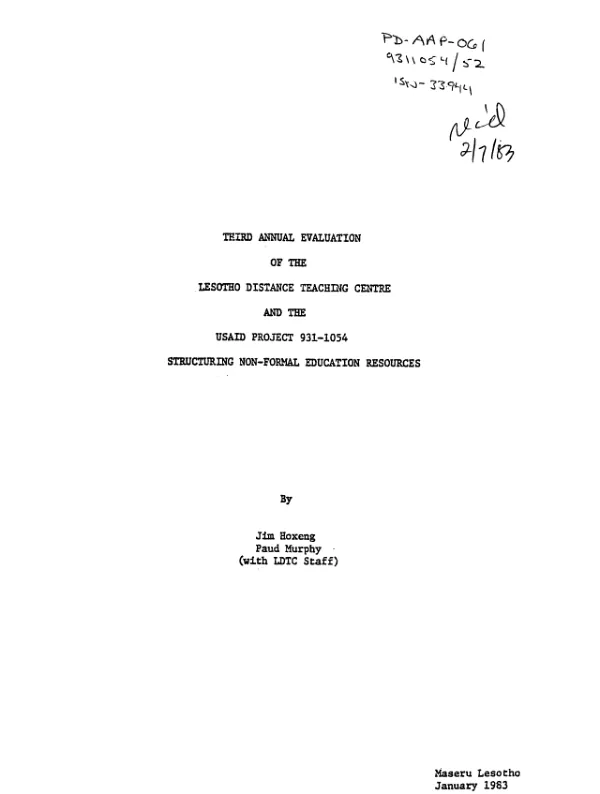
Third annual evaluation of the Lesotho Distance Teaching Centre and the USAID project : structuring non-formal education resources
Sign inLESOTHO DISTANCE TEACHING CENTRE
Third annual evaluation of the Lesotho Distance Teaching Centre and the USAID project : structuring non-formal education resources
Evaluates project to support the development of the Lesotho Distance Teaching Centre (LDTC), a nonformal education (NFE) institution.
Hoxeng, James|Murphy, Paud · 1982
Sign in to readA free account is required to download.
Abstract
Third annual evaluation covers the period 12/81-12/82 and is based on interviews with project personnel and site visits. Due to its focus on institutional development (through a new building extension, long- and short-term TA, and salary support for up to ll local staff), the project has equipped the LDTC to make a major impact on education, training, and income generation among rural groups. For its part, the LDTC, although severely criticizing last year's evaluation, has implemented 30 of its 36 recommendations, a Government of Lesotho (GOL) hiring freeze and other in-country constraints forestalling the others. The LDTC's Service Agency (SA) has made good progress. During the last year, the SA has: increased its staff from 2 to 6 (a major need is to hire a woman as a second NFE officer); completed a major study of NFE; undertaken 30 major interventions under its Assistance Fund (eligibility criteria and procedures for which need refinement); and begun replacing printing as a source of income with other activities such as the provision of innovative training - a field in which SA is becoming a leader. In accordance with a long-term staff development plan it has developed for the LDTC, the project is providing a wide range of in-country and overseas training for LDTC staff. Intensive and ongoing workshops have proven especially worthwhile, although the LDTC should rely more in the future on the SA and encourage only those workshops that directly improve its work. Master's training should be limited to senior LDTC officials. Due to various factors - including the GOL hiring freeze, growth of the SA, and changes in perceived needs - the LDTC is currently considering a reorganization; recommendations include grouping all writers under a single writing section and addressing the serious inefficiency of the printing section. As for the SA, the extent of the GOL's budgetary support in the future will depend on the extent to which GOL leaders have been convinced of the project's impact. Major recommendations are to extend the project a year to 4/30/84 and to conduct an evaluation in mid-1983 to determine the need for a further 2-year extension.