USAID DEC
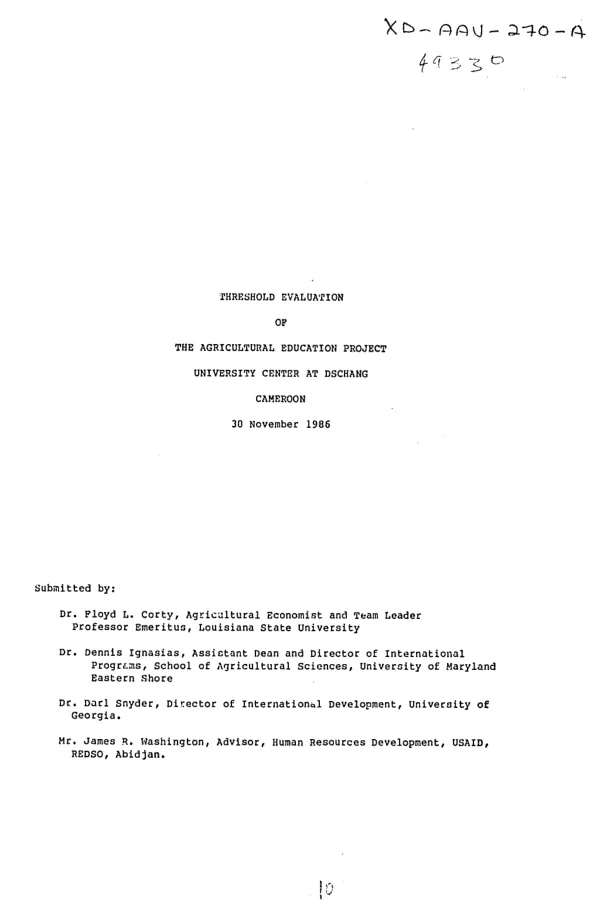
Threshold evaluation of the agricultural education project, University Center at Dschang, Cameroon
Sign inUSAID. MISSION TO CAMEROON
Threshold evaluation of the agricultural education project, University Center at Dschang, Cameroon
Evaluates project to establish an agricultural university (the University Center of Dschang, or UCD) in Cameroon.
Corty, Floyd L.; Ignasias, Dennis · 1986
Sign in to readA free account is required to download.
Abstract
External evaluation covers the period from 6/82 to 11/86 and is based on site visits, document review, and interviews with involved personnel and participant trainees. Substantial progress has been made in several areas. Revision of UCD"s academic and administrative structures to achieve greater operational efficiency is essentially complete. UCD has been divided into 9 departments, offering specialized degrees in crop and animal production, forestry, rural engineering, agribusiness, and rural education and extension. In addition, curricula have been revised, resulting in the replacement of the 2-year Ingenieur Agricoles and Ingenieur des Travaux Agricoles degrees by a 4-year B.S. equivalent program. Progress in upgrading faculty and stimulating research and outreach programs has been good. Thirty-five faculty members are pursuing graduate degrees at U.S. universities, 11 at the Ph.D. level; another 12 have been nominated for U.S. study. Research and outreach programs have been hampered by a lack of suitable facilities and coordination with other government agencies, but progress is acceptable given the comparatively short time UCD has been in operation. Expanded library facilities, creation of a new university-level outreach office, and a stronger presence on the National Committee for Plant Research, which coordinates government research efforts, are needed to make additional progress in these areas. More serious are the problems surrounding the development of three UCD demonstration farms: lack of supervision and equipment have made these facilities almost impossible to use, a serious obstacle to creating a balanced research program. Construction of other essential buildings (e.g., dormitories, classrooms) is about 2 years behind schedule, due primarily to poor planning and building design, and probably will not be completed when the project ends in 1989. Efforts to establish a motor pool and physical plant maintenance services have been unsuccessful as well, due in part to lack of supervision, training, or adequate compensation. In sum, while the project has achieved significant momentum, about half of its outputs remain to be accomplished, and are in fact dependent upon completion of construction and further development of the research and outreach programs (which in turn depend upon the participants" return). The project design allotted too little time for institution building and it failed to understand that the U.S. land grant model cannot be imposed in Africa. It is essential that an indigenous model for integrating teaching, research, and outreach at universities be allowed to evolve. Numerous recommendations are made.
Related documents