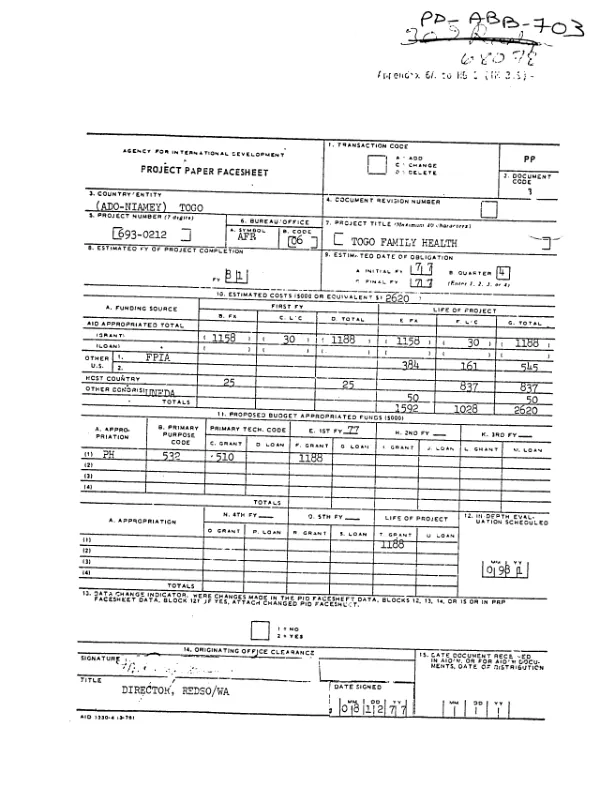
USAID. MISSION TO TOGO
Togo child survival and population
Project to improve family planning and maternal/child health (FP/MCH) services in Togo.
1991
Sign in to readA free account is required to download.
Abstract
The project, to be implemented by the Ministry of Health and Population (MOHP) with contractor assistance, will: (1) improve MOHP management and increase health cost recovery; (2) promote integration and decentralization of MOHP services; (3) promote public and private sector collaboration in service delivery; and (4) expand private sector health care and FP service delivery. To improve MOHP management, the project will: (1) establish a MOHP Directorate of Planning and Training; (2) improve the Directorate of Finance and Administration"s capability to provide personnel management, financial services, and logistical support; (3) simplify and integrate existing health statistics and management information systems (MISs), while improving local health facility staff ability to plan and manage resources; and (4) strengthen the ability of the MOHP"s pharmaceutical distribution service (PharmaPro) to distribute essential drugs and supplies to all levels of health facilities. Activities will include: development of a comprehensive MIS, and of standards, guidelines and protocols for MOHP services and operations; strengthening the MOHP Statistical and Training Divisions; and establishing a MOHP documentation center. A system of fees for medical consultations, contraceptives, and medicines will be put in place at public health facilities, and village development committees and health subcommittees will be developed in the 397 communities where these facilities are located. The committees will be trained to promote community FP/MCH care and to supervise the management of the fees collected. Long- and short-term participant training and in-country training will be among the key inputs. To promote integrated, decentralized service delivery, the project will create multipurpose prefectoral public health teams, headed by Chief Medical Officers to (1) provide medical and technical expertise for all MOHP program interventions; (2) train health staff, to include the establishment of three cycles of technical training covering all aspects of FP/MCH (with curricula and materials to be developed by the MOHP Training Division); and supervise and manage all interventions. Technical reference guides for service delivery, administrative operations, and supervision will be developed. To increase public-private collaboration in delivering FP/MCH services, the project will strengthen the MOHP"s capacity to monitor and provide technical extension services to private practitioners, community health cooperatives, laboratories, and pharmaceutical vendors. Focus will be on integrating these private providers into national health education, statistics, and training networks; ensuring professional standards and certification; and rationalizing household expenditures for essential health care. Lastly, to expand private sector health/FP service delivery, the project will assist in the development of professional associations of health providers, and will make revolving loan funds available to encourage private health personnel to open offices in underserved areas outside of Lome. The project"s FP/MCH objectives are, inter alia, to increase the provision of prenatal care, number of attended births, immunizations, growth monitoring, oral rehydration therapy, condom use, and the availability of modern FP services in public health facilities.
Related documents