USAID DEC
Tomorrow is too late : [recommendations of the] Task Force on Education Reform in Central America
Sign inCORPORACION DE INVESTIGACIONES PARA EL DESARROLLO (CINDE)
Tomorrow is too late : [recommendations of the] Task Force on Education Reform in Central America
Educational development in Central America, Panama, and the Dominican Republic is behind that of South America, which itself trails world indices.
1970
Sign in to readA free account is required to download.
![Tomorrow is too late : [recommendations of the] Task Force on Education Reform in Central America](https://covers.devme.ai/gen/24055.webp)
Abstract
The present document, prepared by the Task Force on Education Reform in Central America, created in early 1999 by the Partnership for Educational Revitalization in the Americas (PREAL), presents and discusses four key recommendations for improving education in the sub-region. (1) Transfer to parents, teachers, and communities a greater share of responsibility for managing educational systems and administering schools. Turning schools into autonomous organizations imbued with their own culture, vision, and sense of mission is essential for the successful management of resources and the improvement of academic achievement. Central America, Panama, and the Dominican Republic are teeming with promising innovations in school autonomy. Their achievements need to be consolidated and replicated. Recent experience demonstrates that educational communities are capable of substantial progress if the management of human and material resources is transferred to the schools themselves. (2) Increase public investment in education to a minimum of 5% of GDP and allocate the new funds to primary and secondary education. In order to improve education significantly, most countries should dramatically increase their investments at the primary and secondary levels. In at least five countries -- Guatemala, El Salvador, Nicaragua, the Dominican Republic, and Honduras -- current levels of public investment are grossly inadequate and fall well below those of other parts of Latin America. (3) Revitalize the teaching profession by linking salaries to job performance, improving pre-service training, and promoting more and better in-service training programs. Current salary and incentive structures value seniority and academic credentials over performance, making it difficult for schools to retain and reward good teachers or replace those who perform poorly. Wage increases must be accompanied by legal reforms that link them to job performance and student achievement. (4) Establish a common system of educational standards and performance assessment, and disseminate findings widely. Countries should establish well-defined, broadly discussed educational standards, implement systematic tests of academic achievement, and establish benchmarks to evaluate the impact of reforms. Standards and test results should be disseminated to parents and society in a simple, transparent manner. Governments should establish a regional, independently administered system of academic achievement tests that allows comparisons across countries. All countries should participate in global testing programs. (Author abstract, modified)
Related documents
Documents in this collection
 1998
1998USAID DEC
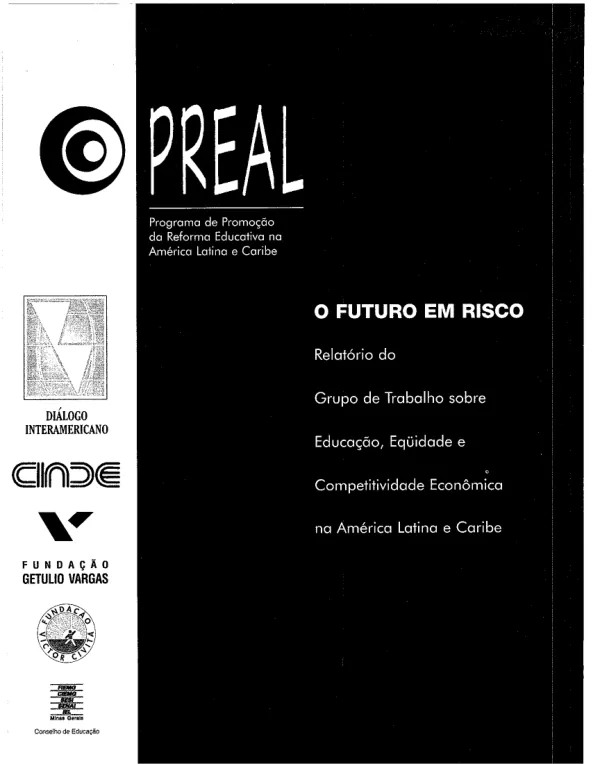
The future at stake : report of the Task Force on Education, Equity and Economic Competitiveness in Latin America and the Caribbean
Open record 1999
1999USAID DEC