USAID DEC
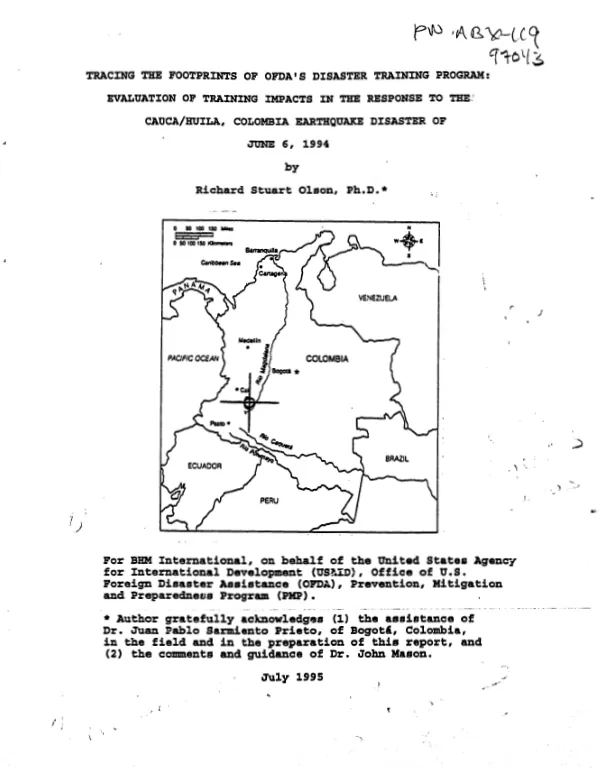
Tracing the footprints of OFDA's disaster training program : evaluation of training impacts in the response to the Cauca/Huila, Colombia earthquake disaster of June 6, 1994
Sign inBASIC HEALTH MANAGEMENT INTERNATIONAL (BHM)
Tracing the footprints of OFDA's disaster training program : evaluation of training impacts in the response to the Cauca/Huila, Colombia earthquake disaster of June 6, 1994
In 1989, USAID's Office of U.S.
Olson, Richard Stuart · 1995
Sign in to readA free account is required to download.
Abstract
Foreign Disaster Assistance (OFDA) initiated a Disaster Training Program for the Latin America and Caribbean (LAC) region. A compound disaster on June 6, 1994, comprising earthquake, landslides, and mudflows in Cauca/Huila in southwestern Colombia and affecting some 28,000 people provided the specific context for this evaluation of the impact of the OFDA/LAC training program. Overall conclusions are as follows. (1) Colombian trainees have changed their normal mode of behavior as well as their disaster mode as a direct result of the training, demonstrating increased competence and professionalism. (2) Several Colombian organizations have adopted and internally funded all or part of the OFDA/LAC curriculum. However, this adoption is not uniform across the relevant organizations (the Colombian military, for example, has not adopted the curriculum at all), and the sustainability of commitments remains questionable. (3) Colombian national response to the 1994 disaster was relatively self-sufficient and required only minor, highly specialized U.S. government relief assistance, especially when compared with U.S. assistance for the Nevado del Ruiz/Armero disaster of 1985. This increasing self-reliance was confirmed when Colombia made no effort to seek U.S. assistance for an earthquake that struck west of the city of Pereira on February 8, 1995. Lessons learned regarding the evaluation process are as follows. (1) Rapid evaluations (i.e., within a few weeks) are the best way to capture reliable data on the impacts of the OFDA/LAC training program, especially on the linkages between training and the actual disaster response. (2) While a random sample of previous trainees would have been methodologically ideal for evaluation purposes, the use of a focus group proved adequate in light of financial limitations and confidentiality and security requirements. (3) A more easily accessible and user-friendly database at OFDA/LAC in Costa Rica would have been useful for collecting data on past trainees. (4) Collaboration between the U.S. evaluator and a host country colleague facilitated the evaluation and added depth and sensitivity to its findings. (5) In the mid to long term, evaluation of the OFDA/LAC disaster training program, especially data collection and preliminary analysis, can largely be turned over to host country individuals. (6) There is significant interest in an evaluation such as the present one, which has been requested in both Spanish and Portuguese translation.