USAID. MISSION TO GUATEMALA
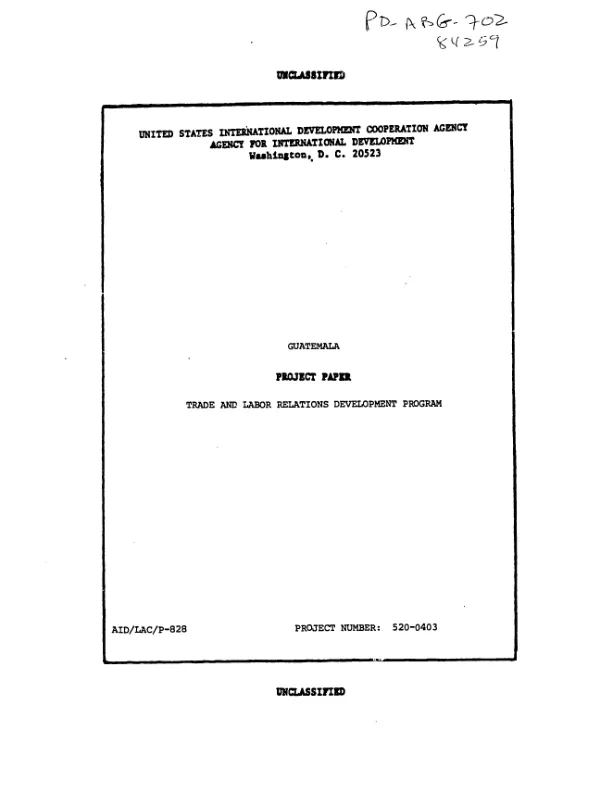
Trade and labor relations development program (520-0403)
Program to promote economic growth in Guatemala by increasing bilateral trade and the participation of the labor force in economic benefits.
1993
Sign in to readA free account is required to download.
Abstract
The program has two components: (1) a nonproject assistance sectoral reform agenda and (2) trade and labor relations project activities. A $3 million ESF cash transfer will support the sectoral reform agenda, which targets policy and regulatory reform in two areas critical to increasing trade and improving the investment environment: protecting intellectual property rights; and improving the investment approval process. The policy agenda also includes covenants requiring the Government of Guatemala to: (1) remain eligible for Caribbean Basin Initiative (CBI) and Generalized System of Preference (GSP) benefits; (2) design legislation to improve the investment dispute resolution process; and (3) reduce non-tariff barriers. Program dollars will be used to import production-related U.S. goods. Local currency generations will support efforts of the Bank of Guatemala and the Ministry of Economy (MOE) to liberalize the trade regime, decentralize the Ministry of Labor (MOL), and implement new labor code reforms. Project activities will complement the sectoral reform agenda via activities in three areas: policy reform for two-way trade, nontraditional export development, and labor relations. (1) To support policy reform for bilateral trade, the Ministry of Economy (MOE) will receive TA and technical training to prepare policy analyses and conduct seminars for decisionmakers. The Guatemalan Enterprise Chamber (CAEM) and the Guild of Non-Traditional Product Exporters (the Gremial) will receive similar but more limited assistance to support private sector participation in the policy reform process. (2) To increase nontraditional exports, the Gremial will increase the provision of market information to exporters, and provide short-term TA and training in the areas of business skills, production techniques, and quality control. The project will also finance participation in trade shows for staff of the Gremial and member firms and will continue to support the Gremial"s Applied Agricultural Research Fund and Integrated Agricultural and Environmental Protection Program. (3) The MOL will take the lead in efforts to improve labor relations, with a focus on implementing, enforcing, and promoting awareness of the reformed labor code; improving labor/management mediation and negotiation skills; and enhancing productivity through improved labor relations. The CAEM, the Gremial, and possibly the U.S. Department of Labor and U.S. university labor relations centers will also provide training in this area. Targeted outputs include, inter alia: enacting internationally acceptable intellectual property rights legislation; creating mechanisms for effective settlement of investment disputes; placing Guatemala in compliance with the terms of its accession to the General Agreement on Tariffs and Trade (GATT); streamlining the investment approval process from 360 days to about 7; and increasing value added in the nontraditional export sector.
Related documents
Documents in this collection
![AID cooperative agreement no. 520-0403-A-00-3257-00 to Gremial de Exportadores de Productos No Tradicionales [Guild of Non-Traditional Product Exporters] to support policy reform, non-traditional export development and improved labor relations under the trade and labor relations development [TLRD] program](https://covers.devme.ai/gen/57604.webp) 1993
1993USAID DEC
AID cooperative agreement no. 520-0403-A-00-3257-00 to Gremial de Exportadores de Productos No Tradicionales [Guild of Non-Traditional Product Exporters] to support policy reform, non-traditional export development and improved labor relations under the trade and labor relations development [TLRD] program
Open record 1990
1990USAID DEC