USAID DEC
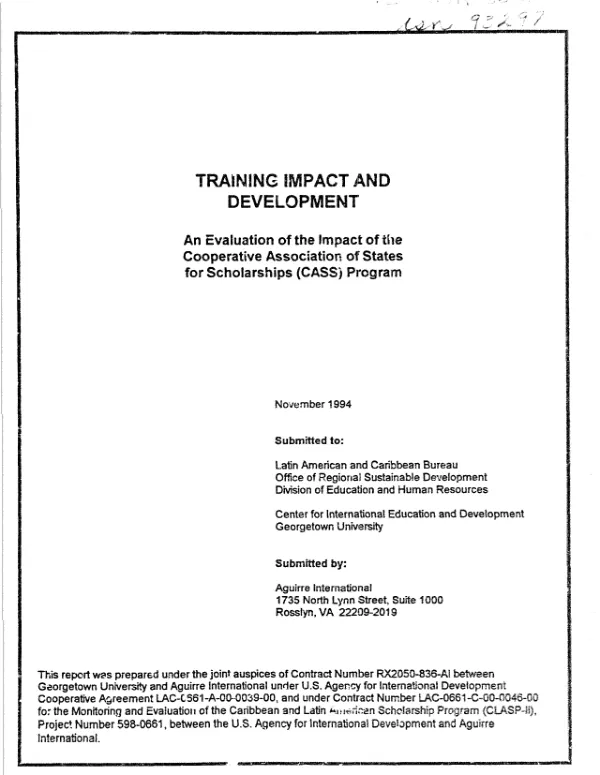
Training impact and development : an evaluation of the impact of the Cooperative Association of States for Scholarships (CASS) program
Sign inAGUIRRE INTERNATIONAL
Training impact and development : an evaluation of the impact of the Cooperative Association of States for Scholarships (CASS) program
Evaluates the Cooperative Association of States for Scholarships (CASS) program to recruit socioeconomically disadvantaged youth from Central America and the Caribbean for technical training in U.S.
1994
Sign in to readA free account is required to download.
Abstract
community colleges. Evaluation covers the period 1990-11/94 and is based on five community colleges and four representative countries (Dominican Republic, Cost Rica, Honduras and Eastern Caribbean). The program has been successful in achieving its stated purpose and, coincidentally, has supported the LAC Bureau's Strategic Objectives, although these were established after the program began. CASS has fostered trainees as change agents, i.e., individuals who have the capacity and motivation to initiate or support sustainable development through their own actions and their influence on others. A large majority appear prepared to take on leadership roles beyond their own communities. Program administration in general is efficient and performing well. However, student recruitment from rural areas is far below the goal of 80%, and some students were poorly prepared to complete the academic program and had poor Spanish skills. Over 80% of trainees were satisfied with course offerings, faculty, host family experiences, and other Experience America activities. English-language training was very successful, as was leadership development. Over 91% of trainees believe CASS improved their self-esteem, and 75% felt they learned something about the U.S. political system that might be useful to them as leaders in the future. The average rate of employment in fields of study and related fields is 79%, and only about 7% are unemployed after returning to their home country. In addition, nearly 85% of trainees report increased responsibilities on the job, 93% have improved income, and 56% have been promoted. The more economically disadvantaged the home country, the more likely trainees are to assess CASS training's importance highly. Some 92% of participants maintain contact with U.S. friends, and 94% maintain communication with other trainees. Their relative success in the workplace and promise of future political activity should have an impact on the democratization of their country and in the maintenance of strong ties with the United States.
Related documents
Documents in this collection
 1991
1991USAID DEC
Assessment of the presidential training initiative for the island Caribbean project and the LAC-II training project in Haiti
Open record 1991
1991USAID DEC