USAID. BUR. FOR SCIENCE AND TECHNOLOGY. OFC. OF POPULATION
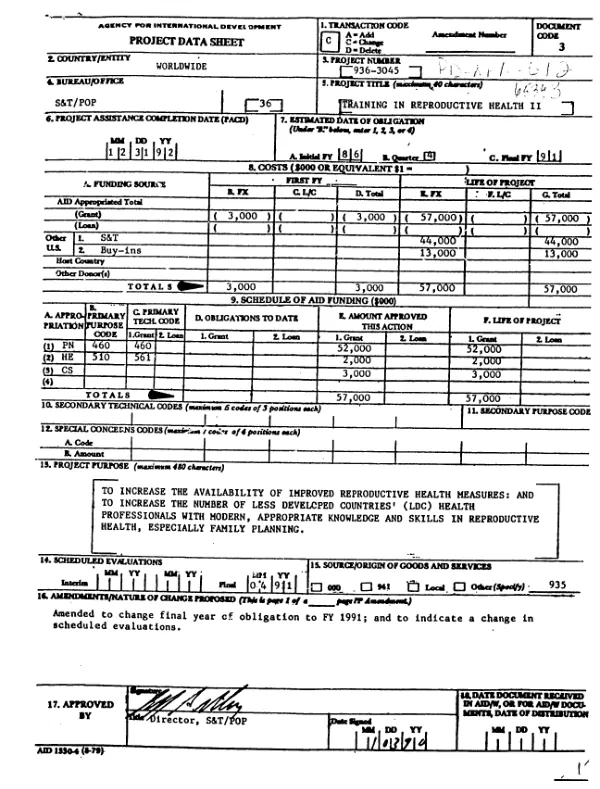
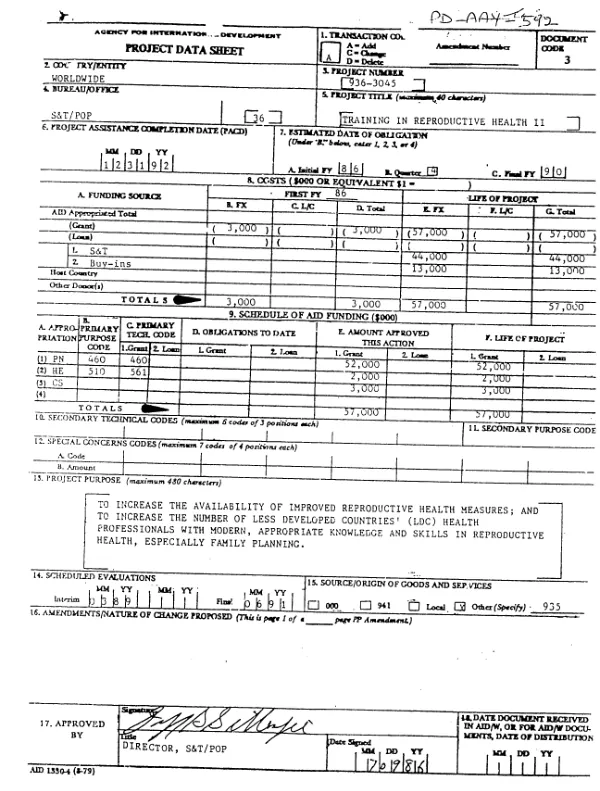
Training in reproductive health II
Project, follow-on to 9320604, to increase the number of LDC professionals trained in modern reproductive health (RH) technologies, especially for family planning (FP).
1986
Sign in to readA free account is required to download.
Abstract
The Johns Hopkins Program for International Education in Gynecology and Obstetrics (JHPIEGO) will implement the project, which has seven components. (1) JHPIEGO will conduct surveys (baseline with updates) of RH content and training technologies/methods in all major medical and nursing/midwifery schools in 20 priority LDC"s, and will review related medical norms and national FP policies. (2) JHPIEGO will develop and update model RH curricula and related materials. Outputs include: 2 new courses for JHPIEGO"s U.S. training center; 2-4 courses/year in each of 9 regional training centers; and prototype basic curricula for medical and for nursing/midwifery schools in LDC"s. (3) JHPIEGO will develop strategies to institutionalize/update the teaching of FP as part of RH training, with increased attention on country programs. Some 20-50 key educational institutions in 20 priority LDC"s will substantially improve their RH training. (4) At its U.S. center, JHPIEGO will train 200 medical school and 200 nursing/midwifery school faculty, as well as 500-1,000 other LDC professionals in modern RH skills and technologies. (5) To help LDC"s institutionalize RH training programs, 20-40 programs a year (including 5 new programs each year) will be introduced or maintained worldwide. In all, 8,000-10,000 professionals and 10,000-30,000 students in 25-35 LDC"s will be trained in country or regional programs supported by JHPIEGO. (6) Laparoscopic equipment, minilaparotomy and IUD kits, and educational materials will be provided to institutions whose trainees have mastered applicable clinical techniques; equipment maintenance will be supported as well. (7) Finally, 9 international fora and 10 meetings of international or regional councils and/or advisory groups will be held, and JHPIEGO will put increased emphasis on RH-related TA independent of country projects, e.g., TA to USAID"s. As a result of the project, 500-1,000 LDC health clinics will be staffed with personnel trained to provide RH care.