USAID. BUR. FOR LATIN AMERICA AND THE CARIBBEAN. REGIONAL DEVELOPMENT OFC.
Training of Honduran electricians and mechanics in the US
Evaluates project to provide Honduran electricians, mechanics, and management personnel with U.S.
Bernbaum, Marcia; Leon, Humberto · 1984
Sign in to readA free account is required to download.
Abstract
technical and supervisory training and with exposure to U.S. industrial firms similar to their own. Final PES covers the period 1/83-8/84 and is based on the document review, site visits, and interviews with trainees and supervisors conducted under an unattached special evaluation. Project results have been mixed. U.S. training, provided to 24 participants (15 from the private sector, 8 from the National Institute of Vocational Training, and 1 from a PVO training center) at Miami Dade Community College, was particularly successful in the areas of industrial electronics and supervisory and pedagogical skills; most training expectations were met, tests revealed that new skills were acquired, and job performance showed improvement. However, industrial mechanics training failed to utilize individualized instruction, as planned; instead a locked-step approach was adopted, training took longer than expected, and trainees had to return to Honduras before course completion. Due also to the group teaching strategy and to weak training-needs assessments, 26% of the technical skills taught (especially those in electronics) were found to have no current or anticipated application in Honduras. The very traditional pedagogical skills taught could have been provided in Honduras for much less cost. Although the multiplier effect was achieved for vocational center participants, private industry trainees lacked the support needed to transfer their new skills to coworkers. Finally, lack of time cut short the planned two weeks of on-the-job, in-plant training. Lessons learned are: training programs of this type are more appropriate for large businesses, transnationals, and vocational training centers; it would be more cost-effective to supplement and use host country training resources than to provide U.S. training; individualized, open entry-exit training strategies are more appropriate and cost-effective than traditional, locked-step instruction; a site visit should be made to determine whether a contracted institution can provide the required training; and an improved project design and greater effort by the training institution would be required to achieve a multiplier effect.
Related documents
Documents in this collection
 1984
1984USAID DEC
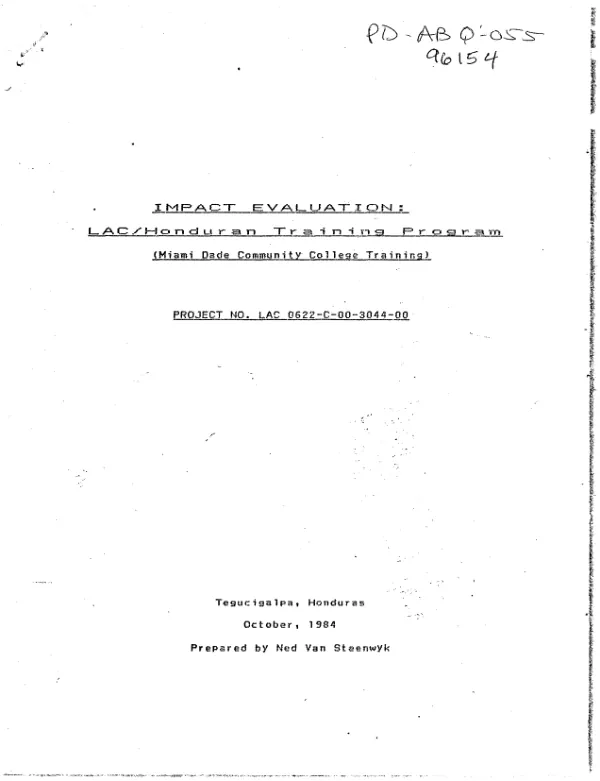
Impact evaluation : LAC/Honduran training program (Miami Dade Community College training) -- project no. LAC-0622-C-00-3044-00
Open record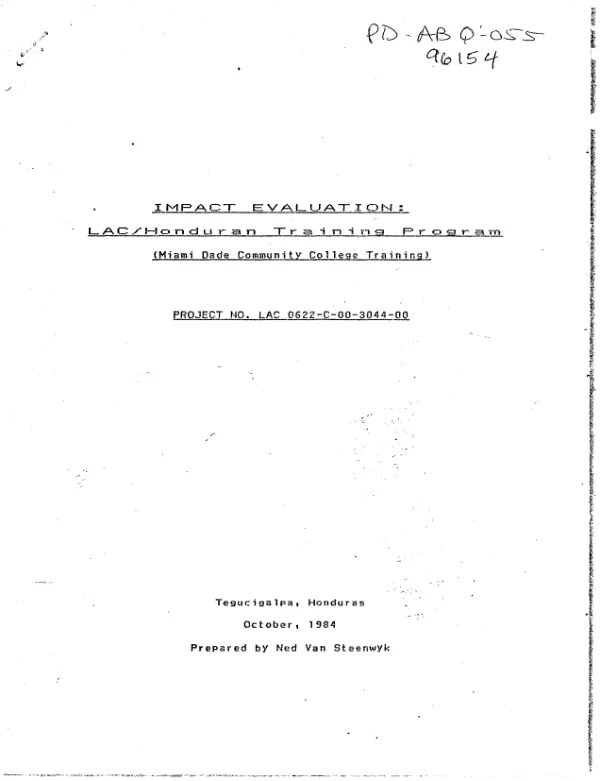 1984
1984USAID DEC