USAID DEC
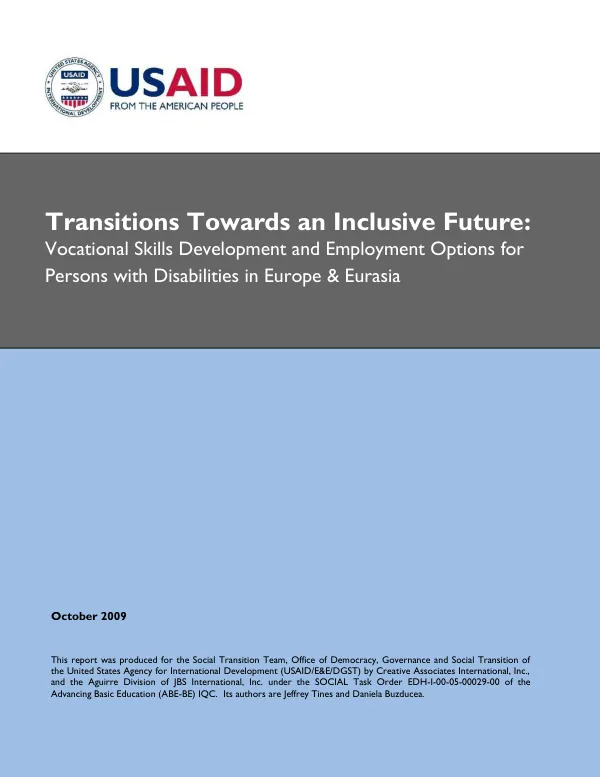
Transitions Towards an Inclusive Future: Vocational Skills Development and Employment Options for Persons with Disabilities in Europe & Eurasia
Sign inCREATIVE ASSOCIATES INTERNATIONAL INC.
Transitions Towards an Inclusive Future: Vocational Skills Development and Employment Options for Persons with Disabilities in Europe & Eurasia
Vocational Skills Development and Employment Options for Persons with Disabilities in Europe & Eurasia The report highlights the need for inclusive vocational skills development and employment options for persons with disabilities in Europe and Eurasia.
2009 · 57 pages
Sign in to readA free account is required to download.
Abstract
The prevalence of disability in the region is significant, with an estimated 10% of the population living with a disability. Service delivery systems for persons with disabilities are often fragmented and inadequate, with limited access to education, vocational training, and employment opportunities. The report emphasizes the importance of a rights-based approach to disability, which recognizes the inherent dignity and worth of individuals with disabilities. This approach is essential for promoting inclusive education and vocational training, as well as employment opportunities that are accessible and equitable. The report also highlights the need for models and best practices in vocational training and employment for persons with disabilities, drawing on international good practices and strategies. Vocational training and employment options for persons with disabilities are critical for promoting social inclusion and economic participation. The report identifies several internationally applied vocational training strategies and models, including specialized, segregated vocational training, inclusive vocational training, employment trial vocational training, on-the-job vocational training, and apprenticeship. These models aim to provide persons with disabilities with the skills and knowledge needed to access employment opportunities and participate in the labor market. The report also highlights the importance of employment options that are accessible and equitable for persons with disabilities. These options include open, competitive employment, including self-employment, sheltered employment, supported employment, and social enterprises. These options aim to provide persons with disabilities with the opportunity to work in a supportive and inclusive environment, while also promoting their economic participation and social inclusion. The report concludes with recommendations for next steps, including the need for governments, civil society organizations, and international partners to work together to promote inclusive vocational skills development and employment options for persons with disabilities. The report emphasizes the importance of setting specific benchmarks and objectives, as well as developing strategies and models that are tailored to the needs of persons with disabilities in Europe and Eurasia. The report highlights the need for a comprehensive approach to promoting inclusive vocational skills development and employment options for persons with disabilities. This approach should involve governments, civil society organizations, and international partners working together to develop and implement policies, programs, and strategies that promote social inclusion and economic participation. The report also emphasizes the importance of monitoring and evaluating the effectiveness of these efforts, in order to ensure that persons with disabilities have access to the skills and knowledge needed to participate fully in the labor market. The report provides a comprehensive overview of the challenges and opportunities facing persons with disabilities in Europe and Eurasia. It highlights the need for a rights-based approach to disability, as well as the importance of promoting inclusive vocational skills development and employment options. The report also emphasizes the need for governments, civil society organizations, and international partners to work together to promote social inclusion and economic participation for persons with disabilities.
Related documents