USAID DEC
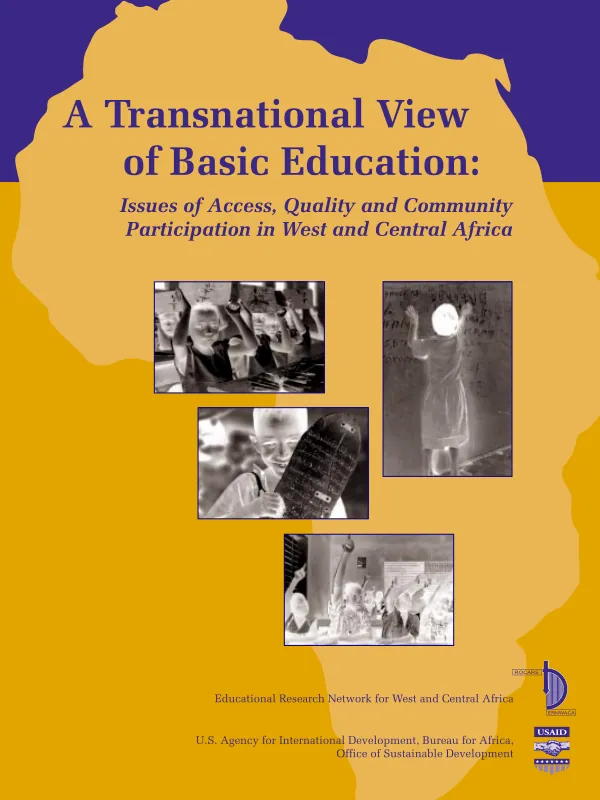
Transnational view of basic education : issues of access, quality and community participation in West and Central Africa
Sign inACADEMY FOR EDUCATIONAL DEVELOPMENT, INC. (AED)
Transnational view of basic education : issues of access, quality and community participation in West and Central Africa
This document synthesizes the main findings of studies produced by seven member countries of the Educational Research Network for West and Central Africa (ERNWACA) on common ways to develop and implement policies to combat rising illiteracy, grade-repetition, drop-out rates, and school expulsions in Africa.
2002
Sign in to readA free account is required to download.
Abstract
The studies focused on: access to schooling and the retention of students within the primary sector in Ivory Coast and The Gambia; and the relation between community participation and access to and quality of education in Benin, Cameroon, Ghana, Mali, and Togo. The results of the Ivory Coast studies show the following: (1) Demographic growth limits access and retention. (2) Religious beliefs, especially fears linked to conversion efforts by the Christian church and to delayed marriage for girls, negatively influence the demand for education. (3) Parents" perception of education determines the length of children"s schooling. (4) The quality of education is proportionate to access and retention. Findings regarding Benin, Cameroon, Ghana, Mali, and Togo are as follows: Community participation is many faceted, but its impact is uneven. At present, communities participate in basic education on a partial basis. When they do organize themselves to participate, it is often under the impetus of outside agents, especially the government and NGOs. Furthermore, in most countries, educational participation remains very low, despite the dynamism of the Students" Parents Associations. New forms of community participation have proven very effective in increasing access to and quality of education in Ghana. Some factors have a direct impact on community participation. In Cameroon, the best results have been achieved in communities that have a positive perception of basic education, regular and stable household incomes, a history of organized social mobilization, a form of educational involvement that goes beyond financial contributions, and the presence of an external support or development mechanism and role models whose social status derives from their education. In Benin, the main factors favoring community participation are: the profitability of income- generating activities; community involvement at each stage of the decisionmaking process; government aid; the good results achieved by students on completion of their studies; the willingness to develop the community; and the creation of an effective institutional framework. In Ghana, factors with a positive influence on community participation include: community perception of the usefulness of their participation; the existence of organized groups and the quality of their leadership; the quality of community communication with the Ministry of Education and between members of the teaching staff and members of the community; the degree to which community members meet their educational responsibilities; and the degree of encouragement and support for school-related community initiatives. Community participation is seriously hampered by poverty, illiteracy; the lack of jobs for school graduates; and ignorance of the concept of free schooling. The effect of participation on access and quality varies according to the type of school, its approach to education, and its history. Thus, In Mali, even though high participation may correlate with an increase in access, this effort is most strongly felt in community schools and literacy centers; only the latter correlate highly with student acquisition of knowledge. Communities cannot improve access and quality on their own. Obstacles to improving quality include failure to integrate society"s values into school curricula; limited acquisition of basic knowledge and skills by the students, notably girls; poor learning conditions (shortage and inappropriateness of textbooks, overcrowded schools, obsolete teaching methods, poorly qualified teachers); and inappropriate management of parents" school fees. Integrating communities into the educational system is based on the following factors: schools are not managed with a long-term perspective, which involves rigorous strategic planning; people are not accustomed to integrating the school into a development project; school officials are not trained to define their actions within a development perspective; and the relationships between communities and school authorities are complicated by the latter"s reluctance to share decisionmaking powers and by the weight of bureaucratic tradition. Includes recommendations.
Related documents
Documents in this collection
 2002
2002USAID DEC
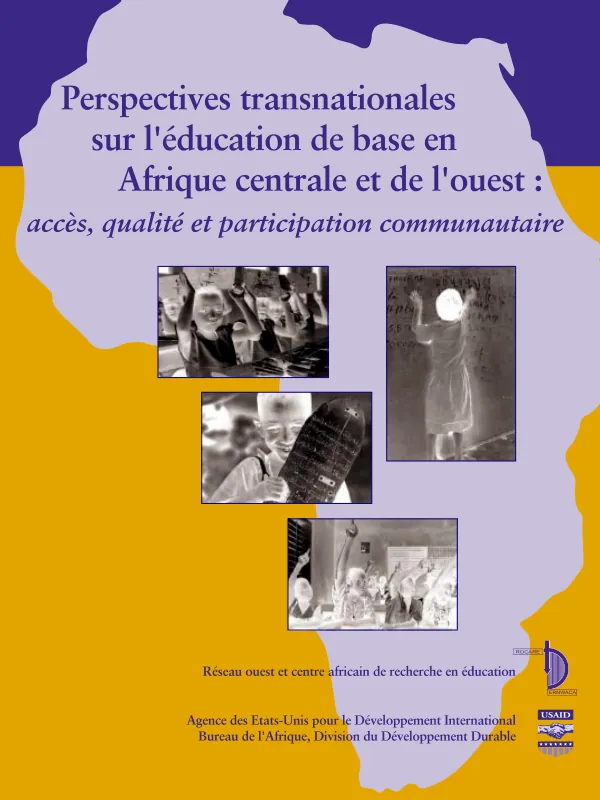
Perspectives transnationales sur l"education de base en Afrique centrale et de l"ouest : acces, qualite et participation communautaire
Open record![Overlooked and undervalued : a synthesis of ERNWACA [Educational Research Network for West and Central Africa] reviews on the state of educational research in West and Central Africa](https://covers.devme.ai/gen/65178.webp) 1997
1997USAID DEC
![Negligee et sous-estimee : la recherche en education en Afrique centrale et Afrique occidentale : un synthese d"etudes nationales du ROCARE [Reseau ouest et centre africain de recherche en education]](https://covers.devme.ai/gen/65155.webp)