USAID DEC
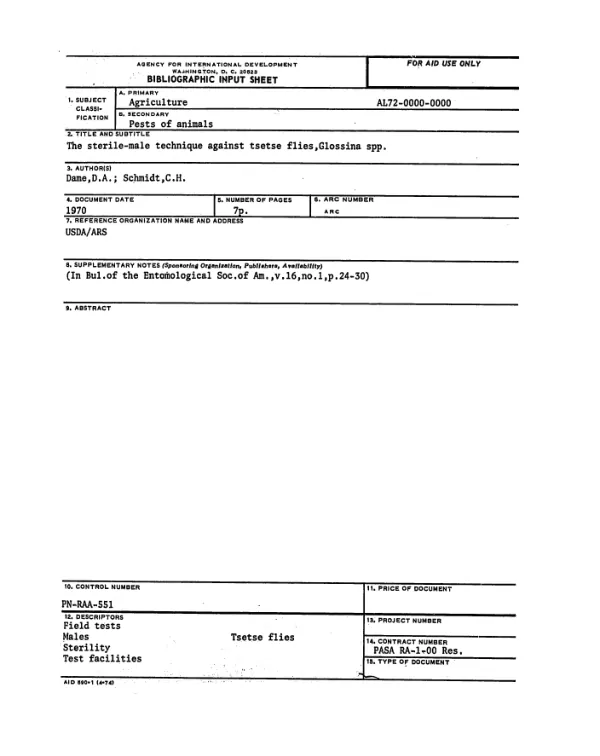
TSETSE FLY ERADICATION AND ITS IMPLICATIONS
This paper considers tsetse fly eradication and its implications in a broad context.
SHAFER, MICHAEL · 1970
Sign in to readA free account is required to download.
Abstract
Tsetse fly control is discussed in terms of both the problems it poses which are specific to tsetse flies and trypanosomiasis and those which pertain to larger issues such as new lands development and resource protection of which tsetse fly control is but an aspect. The author attempts to draw together many diverse strains of thought from a wide range of sources and to present in succinct form the major issues raised by the possible development of cheap and effective eradication technologies. There are thirty some species and sub-species of tsetse fly each with a preferred habitat and well-defined behavior patterns. Thus, in a given area, plans for the eradication of tsetse flies must be targeted for the species of fly present. Modern eradication technologies can effectively clear tsetse flies from the control area. The ease, effectiveness and relative low cost with which tsetse can be controlled raise the question of the land use implications of tsetse fly eradication. This paper addresses itself to these secondary imparts. Tsetse fly eradication projects must be part of a broader development effort attacking all relevant constraints. Failure to manage any one may limit the success of the whole program for an eradication project to succeed, a land use scheme for the entire area must be ready to be put in place immediately. The maintenance of fly barrier zones around control areas must be guaranteed until habitat modification and game displacement have rendered them unacceptable to tsetse fly. Without concurrent population control efforts tsetse fly eradication will be only a short-term palliative. Limited alternatives to tsetse fly control exist for the development of the fly belt. Further research is needed and more consideration should be given to such options as tourism.
![ICIPE"s [International Centre of Insect Physiology and Ecology] long-term vision and strategy toward 2020](https://covers.devme.ai/gen/82449.webp)