DUAL & ASSOCIATES, INC.
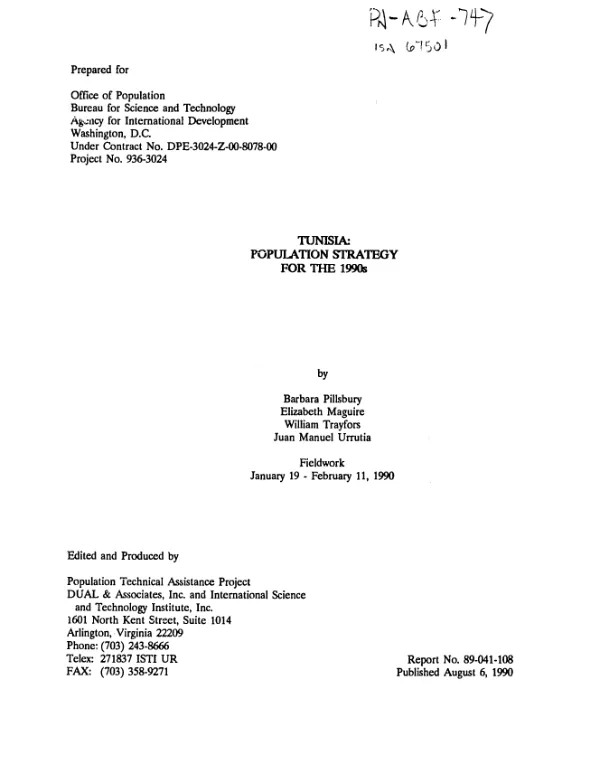
Tunisia : population strategy for the 1990"s
With its progressive policies and vigorous family planning (FP) program, Tunisia has achieved the highest level of contraceptive use in the Middle East and Africa, and is among the leaders of developing countries in recognizing the importance of FP.
Pillsbury, Barbara L. K.; Maguire, Elizabeth · 1990
Sign in to readA free account is required to download.
Abstract
The semiautonomous National Office for the Family and Population (ONFP) serves as a model for A.I.D. assistance, combining private sector, market-related objectives with its FP strategies. This paper details a strategy for ONFP, A.I.D., and other donors to follow during the 1990"s. Chapter topics include: country/policy context and the impact of past A.I.D. assistance; Tunisian and A.I.D. overall policy goals for the 1990"s; FP objectives and strategies for the 1990"s; ONFP"s strategy of privatization, integration (of FP into basic health services), and transformation (from the role of provider to coordinator); financial resources; the role of A.I.D.; and priorities for action. Major conclusions are as follows. (1) Despite current high contraceptive use, overall fertility and population growth rates remain high at 4.3% and 2.4%, respectively. Total contraceptive prevalence is now about 50%, but 10% is for less effective, traditional methods. (2) Further advances in FP are needed, since reducing the population growth rate is essential for carrying out risky economic and political reforms, i.e., structural adjustment. (3) Political commitment to FP remains strong. (4) ONFP has an appropriate but ambitious strategy of evolving from a government monopoly providing free FP services into a coordinator of services provided largely via the marketplace and paid for increasingly by consumers. (5) Despite growing capacities, the ONFP will continue to need external assistance to implement its strategy and achieve self-sufficiency.
Related documents