USAID DEC
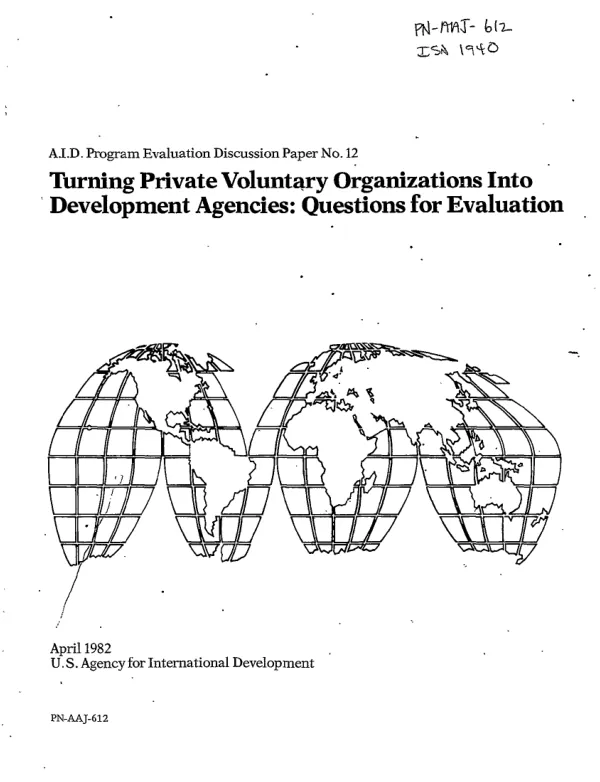
Turning private voluntary organizations into development agencies : questions for evaluation
Sign inUSAID. BUR. FOR PROGRAM AND MANAGEMENT SERVICES. OFC. OF PROGRAM AND MANAGEMENT SUPPORT
Turning private voluntary organizations into development agencies : questions for evaluation
To improve the analytic quality and policy relevance of A.I.D.'s evaluation of projects carried out by private voluntary organizations (PVO's), this report, based on a review of 75 such evaluations (conducte by A.I.D., third party contractors, and PVO's themselves), discusses key issues in PVO project evaluation.
Tendler, Judith · 1982
Sign in to readA free account is required to download.
Abstract
To help evaluators move beyond the rhetoric which PVO's generally use to distinguish their approach from that of large donors (e.g, that it is participatory, targets the poor, and is innovative), the author probes, often by way of questions left unanswered, the features of PVO projects and finds them paradoxical. Participation, for example, often signifies decentralized decisionmaking by local elites, a feature which may or may not benefit the poor (examples are provided) or may benefit them only through the trickle down effect criticized by PVO's themselves. Discussion is given to three aspects of PVO projects which make the poor seem more unreachable than they actually are: the PVO turns from relief to income-earning efforts and from small to large projects and PVO neglect of women's issues. Although PVO's contrast themselves with the public sector, their efforts partly depend on their various types of relations with host country governments (complementarity, competition, replication, filling in "unoccupied territory", takeover by the government, and brokering between government entities and the poor). Evaluators of PVO efforts must determine which relations are operative, whether project success was due to PVO efforts, and instances of impact (e.g., when a PVO project serves as first stage of an effort later amplified by the government). Although PVO's claim to be innovative, many of their projects fall below the state-of-the art. The innovativeness of PVO small-business credit projects is examined in detail. A discussion of deficiencies in evaluations of PVO projects concludes by noting that evaluations should determine how decisionmaking is being done, who benefits from the project, and what is successful or not, including unanticipated successes. Key elements to be considered in determining project success are project type, time or place of implementation, and the PVO-government relationship. Appendices include extensive suggestions to evaluators and a 178-item bibliography (1966-82).
Related documents
![Impact assessment of the AG/NRM [agriculture/natural resource management] strategic objective of USAID/Senegal (OLD SO2) : volume 1 of 3](https://covers.devme.ai/gen/33763.webp)
![Impact assessment of the AG/NRM [agriculture/natural resource management] strategic objective of USAID/Senegal (OLD SO2) : volume 1 of 3](https://covers.devme.ai/gen/5635.webp)