USAID DEC
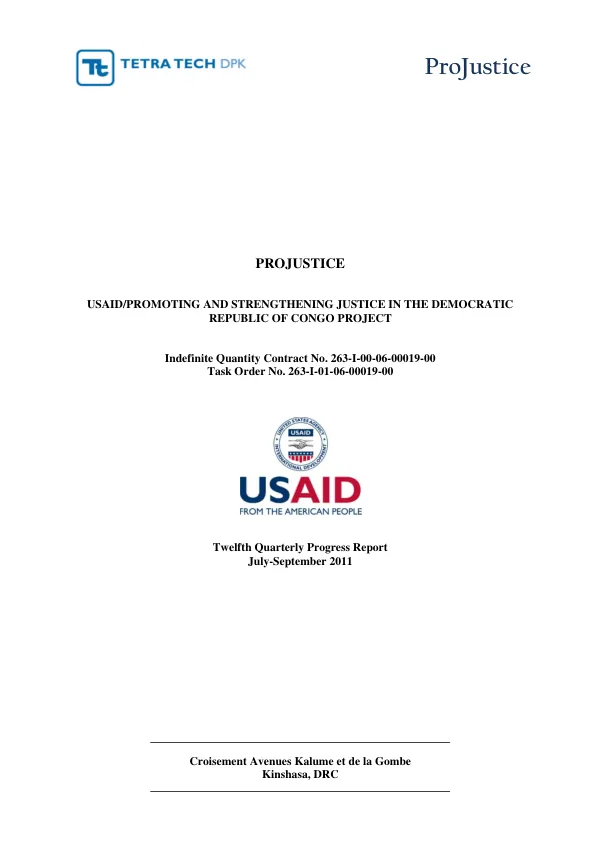
Twelfth Quarterly Progress Report: USAID/PROMOTING AND STRENGTHENING JUSTICE IN THE DEMOCRATIC REPUBLIC OF CONGO PROJECT
Sign inUNITED NATIONS ENVIRONMENTAL PROGRAMME , NAIROBI
Twelfth Quarterly Progress Report: USAID/PROMOTING AND STRENGTHENING JUSTICE IN THE DEMOCRATIC REPUBLIC OF CONGO PROJECT
The establishment of transparent procedures for the recruitment, selection, and promotion of magistrates is a key objective of Component 1 of the ProJustice project.
2011 · 43 pages
Sign in to readA free account is required to download.
Abstract
To achieve this goal, ProJustice has been working closely with the Conseil Supérieur de la Magistrature (CSM) to develop and implement merit-based criteria for the recruitment, selection, discipline, and promotion of magistrates. This effort aims to ensure that magistrates are appointed and promoted based on their qualifications and performance, rather than personal connections or other factors. The CSM has adopted and implemented transparent merit-based criteria for the recruitment, selection, discipline, and promotion of magistrates. This development is a significant step towards establishing a more transparent and accountable judicial system in the Democratic Republic of the Congo (DRC). However, challenges remain, as many magistrates in the DRC lack knowledge of laws governing disciplinary proceedings against magistrates who violate their codes of ethics. Disciplinary Boards, which adjudicate alleged breaches of ethics and professional conduct codes, often come to inconsistent interpretations of how the laws should be enforced. This inconsistency is partly due to the lack of state funding for these bodies, as the Congolese Government has never allocated money to cover their operating costs. As a result, heads of jurisdictions and offices often ignore disciplinary procedures, further exacerbating the problem. To address these challenges, ProJustice is providing technical assistance to the CSM to support the establishment of new judicial institutions in the DRC. The project is working to develop and implement effective disciplinary procedures, as well as provide training and capacity-building programs for magistrates and other judicial officials. In addition to its work on Component 1, ProJustice is also supporting the development of other key components of the project. Component 2 focuses on enhancing effective and transparent management of the judiciary and Ministry of Justice and Human Rights (MOJHR). This component involves providing training and capacity-building programs for clerks and prosecutors' secretaries, as well as supporting the École de Formation et de Recyclage du Personnel Judiciaire (Institute of Judicial Training and Retraining). ProJustice has completed a series of three modules on the training of clerks and prosecutors' secretaries in each of the four pilot sites. The project team has decided to monitor and evaluate the sessions, with the first evaluation taking place in Maniema Province (Kindu). The activity is included in ProJustice's annual plan for the first quarter of Fiscal Year (FY)12. Component 3 focuses on more effective, transparent, and accessible court operation in pilot jurisdictions. ProJustice has supported the archiving and processing of case files in the pilot courts in three provinces, organizing 8,582 files into new folders made available to the courts. The project has also provided financial support for the installation of internet service at the Bukavu courthouse, enhancing the ability of court officials to pursue legal research and use e-mail. Component 4 focuses on increased access to justice for vulnerable populations. ProJustice has provided technical and financial support to the Bukavu Bar Association in the organization of a workshop for capacity building of young lawyers. The workshop allowed the lawyers to receive training and information on legal aid to be provided to vulnerable persons in accordance with fair trial standards. In addition to its work on the four components, ProJustice has also identified several "windows of opportunity" for the project. The CSM has requested and received ProJustice assistance in funding internet installation along with three months of internet subscription at the CSM Permanent Secretariat (PS) premises. The Justice Palace in Kindu has also received support from ProJustice to begin renovations to improve court operations, with renovations expected to cost approximately $30,000. Overall, the ProJustice project is making significant progress in its efforts to support the establishment of new judicial institutions in the DRC. Through its work on the four components, the project is helping to develop a more transparent and accountable judicial system, as well as increase access to justice for vulnerable populations.
Related documents