ACADEMY FOR EDUCATIONAL DEVELOPMENT, INC. (AED)
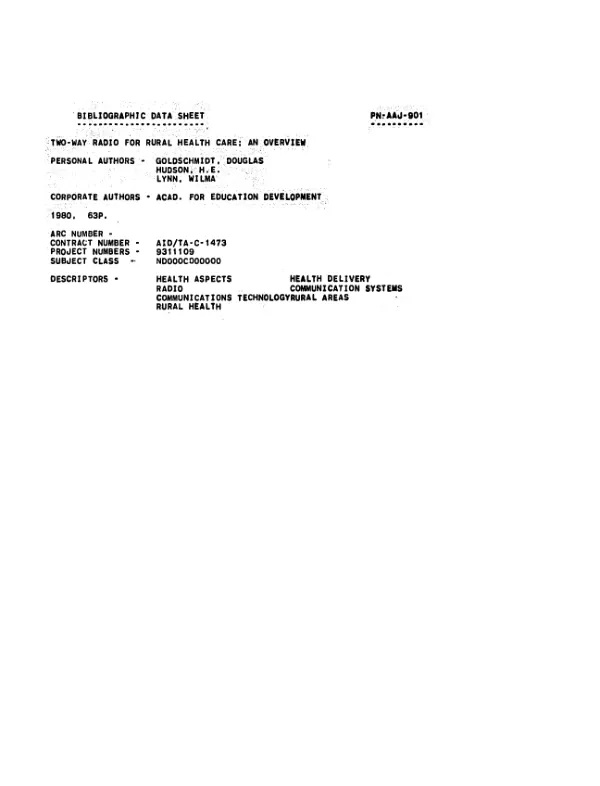
TWO-WAY RADIO FOR RURAL HEALTH CARE; AN OVERVIEW
Increasing attention is being devoted to developing innovative ways of extending health care to rural areas.
GOLDSCHMIDT, DOUGLAS; HUDSON, H. E. +1 more · 1970
Sign in to readA free account is required to download.
Abstract
Toward this end, two-way radio is an effective tool which embodies technology appropriate to rural needs, is easy to maintain and use, and is relatively inexpensive. Based on developed and developing country experience, this report outlines the operation, uses, and possible problems of applying two-way radio to rural health care delivery. Experience has shown two-way radio to be most useful in medical consultation, referral, and administration; coordinating patient transport; providing continuing education to rural health workers; relaying non-health messages; and responding to disasters. A radio systems" actual use, however, will depend on the design of both the health care system and the radio network, the health workers" training and degree of isolation, and the type of assistance available by radio. When implementing a communication system, both capital costs -- the cost of buying and installing the equipment (i.e., a transceiver and an antenna), and operational costs -- the cost of power (e.g., AC current, a battery, a small generator, solar collector panels), maintenance, personnel, and equipment depreciation must be considered. While it is often difficult to establish precise causes when a radio system fails, poor system design, failure to meet the user"s perceived needs, insufficient training of users, inadequate operation and maintenance procedures, lack of spare parts, and/or power supply problems are likely contributors. In addition, although using contractors may ensure technical competence, the cost and quality of operations can still be quite variable. Summaries of North American projects using narrowband technologies for transmission of visual information, heart sounds, EKG"s, and patient record data are also given. Appended are a breakdown of radio system costs in Guyana, Bangladesh, and Nicaragua; a summary of two-way communication technologies; summaries of 53 two-way communication projects for health services delivery; and a 47-item bibliography (1973-80).
Related documents